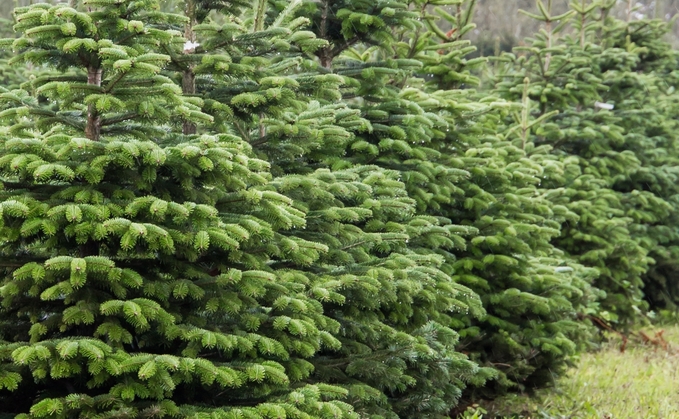
Christmas trees can be a challenging crop to grow, not least because of the time required between planting and harvest, with the British Christmas Tree Growers Association estimating a 6-7 foot tree is typically in the ground for 10-12 years.
Careful site selection, ground preparation, establishment, and management throughout this growing period is therefore key to success, says Hutchinson's horticultural agronomist, Abi Rayment.
Read more: Growing Christmas perfectly with UK produced trees
"Weed control is one of the secrets to getting good establishment, along with good nutrition and an integrated approach to pest and disease control," she says.
Weed control programmes are usually based on an application of glyphosate and a residual herbicide in the dormant season, October to February, followed by another residual herbicide in the spring (March/April), she explains. This may be supported with further foliar contact herbicides applied to weed populations if required during the growing season, especially for specific problem weeds, such as willowherb, and various other broadleaved, and annual weeds.
Read more: Some reason for Christmas cheer around the dining table
A range of herbicides are available for use in Christmas trees, which are classified either as a specific crop, or as an ‘outdoor ornamental crop' for regulatory purposes, she notes. "You can also use selected products authorised for use on all non-edible crops. However, some require an EAMU (off-label approval) and this can be checked using the CRD pesticide database online."
Herbicide choice largely depends on the target weed spectrum, application timing, and whether it will be used just between the rows, or over the whole site.
Watch for pests
Pest control through the growing season is very important, with aphids and adelgids (e.g. the woolly aphid) generally posing the greatest threats, says Ms Rayment.
The silver fir adelgid (a.k.a. woolly aphid), for example, can be found most of the year on woody parts of Nordmann Firs, while the green spruce aphid can be a major pest of Norway and Blue Spruce crops, typically flying in during late August/early September, and will multiply in mild winters, causing severe damage by January if left unchecked.
Read more: Shoppers splashed out on food at Christmas
"If you're unable to spray in autumn due to harvesting, then spray immediately after Christmas, avoiding frosty conditions," Ms Rayment advises. November through to February is also a good time to control other overwintering adult aphid species, such as the pineapple gall woolly aphid and Douglas Fir woolly aphid, if required, she says.
"Mites, such as the conifer spinning mite or rust mite, can also be a problem in hot seasons, and occasional issues with caterpillars and cutworms can also occur."
Wet weather
Diseases are generally rarely a problem in Christmas trees, but if they do occur, it is likely to be in wetter parts of the UK, or associated with extreme rainfall in other areas, says Ms Rayment.
Phytophthora root rot in Noble and Fraser Firs, for example, is often associated with poor drainage and heavy soils, while potential issues to be aware of in Nordmann Firs include current season needle necrosis, Delphinella shoot blight, and rust, which has an alternate weed host of willowherb.
"Although there has been a loss of some key go-to active ingredients over the years, there are still several other control products containing conventional or bio-rational chemistry available if required, so speak to your agronomist about the best options," she concludes.