


Model X is US car maker Tesla's alternative answer to fossil fuel-powered premium SUVs, such as the Range Rover, Porsche Cayenne and Volvo XC90.
This stealthy 4x4 is one which can seat up to seven in comfort, while delivering zero emissions from its all-electric powertrain. It also packs enough propulsion to make supercars wince at the traffic light Grands Prix.
How? Model X's floor is stuffed with 100kW of lithium ion batteries. It is weight you can feel when piloting the 2.5-tonne Model X, but you will momentarily forget about it each time you tap the accelerator and launch the 100D as if you are leaving the deck of an aircraft carrier.
Where a screaming engine assaults your senses, this level of near-silent energy can assault your passengers.
Model X comes in three power outputs; 75D, 100D and P100D. Numbers reflect the kWh of battery power under your feet, while the P suffix adds a ‘ludicrous' mode, which catapults this SUV from zero to 60mph in a mind-warping 2.9 seconds.
We tested the modestly powered mid-pack 100D with six seats, and an attention-grabbing 0-60mph time of 4.7 seconds.
All this electrickery adds up to about 600hp, delivered through two digital motors; one for each axle. So you do get permanent four-wheel drive, but no off-road mode and this is one of several areas where its contemporaries have the edge.
Cleverly though, height adjustable suspension gets GPS memory to save you remembering to lift or lower the car each time to return to the same location.
The battery pack creates an ultra-low centre of gravity, but its mass makes the car fidget like an aloof sports car at motorway speeds, despite its air suspension.
Lower speed brings more cushioning and, importantly, more range. Official figures boast a 350-mile range, but 280 miles is more realistic.
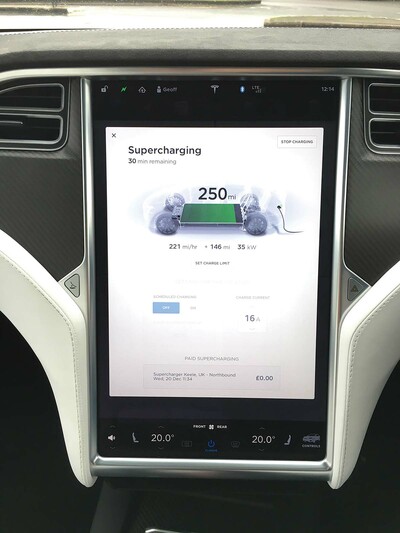
Tesla's own Superchargers - the network is growing, but is some way off being widely available - will give you 50 per cent charge in just 20 minutes.
Getting an 80 per cent fill requires a 40-minute stop. You may end up spending more on coffee and tea.
Model X can be charged from a domestic plug socket, but it adds just six miles of range every hour. An on-farm charging point will be much quicker, and Tesla advises keeping the car plugged in when you are not driving.
It is a bizarre, almost detached, driving experience, which may appeal to your inner tree-hugger.
Fit and finish are still a long way behind the established premium SUV set, and there is too much road noise in the cabin for the price point.
NEED TO KNOW
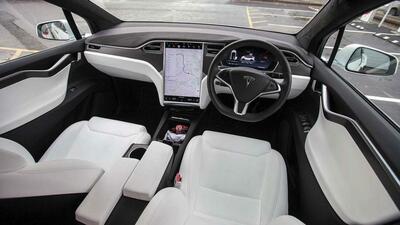
Model: Tesla Model X 100D
Price: £90,800 (£116,730 as tested)
Engine: 100kW Lithium Ion battery pack
Transmission: Two digital electric motors
Performance: 4.7sec 0-60mph, 155mph, 0g/km
Towing capacity: 2,250kg
Servicing: Annually
Warranty: Four-year/50,000 miles and eight-year/infinite mileage battery and drive unit