



On James Henderson's 60-hectare (148-acre) Kilkeel farm on Northern Ireland's south east coast, a shift from set stocking to rotational grazing has increased gross margins to £1,400/ha (£567/acre) by growing 12t/ha (4.8t/acre) of grass annually.
Introducing red clover has slashed artificial nitrogen use to 120-140kg/ha and concentrate use from 1.3t a calf to just 400kg. More recently, introducing multi-species leys has removed concentrate from the sheep enterprise entirely by addressing the farm's early summer forage deficit.
Seafields Farm was a former World War II airfield that was reclaimed by James' father and granddad. James, who was named 2025 British Grassland Farmer of the Year, farms in partnership with his wife Brenda and son Scott and recently spoke on a Germinal webinar about his success.
READ NOW: Careful planning needed before spring grassland work
Improving soil fertility has been their priority. Phosphate and potash indexes now sit at 2, while pH has been corrected to 6-6.5, underpinning the farm's forage performance.
The business runs 310 Belclare cross Aberfield ewes, finishing lambs for Tesco's Sustainable Lamb Group. Alongside the sheep enterprise, 90 autumn-born dairy-cross heifer calves are bought from known sources, reared on milk powder and finished off forage by 22-24 months.
Negating the farm's challenges
The farm is free draining with low annual levels of rainfall of 500-600mm, which James admits can present challenges for their forage-focused system. James has been involved with NI Grass Check for the past eight years, which has helped him better understand seasonal pinch points and he has adapted to make his business more resilient against drier months.
"We can grow incredible amounts of grass in late April and May," he says.
"We now take surpluses during these months and when we get into June and July, bales are rolled out and buffer fed to cattle to maintain performance."
Cattle are managed as two groups – yearlings and second-year heifers. They are rotationally grazed and moved daily, with paddocks split in two using an electric fence to improve utilisation. Younger calves were struggling to clean out pastures, so James began pre-mow grazing every other day.
He says: "Young calves are pickier and were not clearing paddocks well. Pre-mowing has improved utilisation without compromising performance."
First-season calves achieve steady gains of 0.9kg/day on red clover baled silage alongside 2kg of a barley-based home mix during their first winter. Concentrate is tapered off before turnout.
Last season grass analysed at 36% dry matter and 15% protein with a D-value of 70. James says the importance of growing quality silage cannot be underestimated and he aims to make winter forage good enough to feed to dairy cows.
Silage leys contain 3kg AberClaret red clover, 1kg of AberDai and AberSwan white clovers, and 9kg of Aber High Sugar Grass (HSG). Sheep graze new silage leys for three to four rotations to control weeds. In their second winter, cattle gain 0.7kg daily from forage alone.
Multi-species sward leys solve summer deficit
Multi-species swards have further strengthened the system. Traditionally, lambs experienced a growth check post-weaning in June when the farm's grass curve dipped and concentrate was often required.
Following winter barley, James established a multi-species mix of 2kg red clover, 1kg white clover, 2kg plantain, 1kg chicory and 8kg of Aber HSG.
READ NOW: Farm-based fertiliser manufacture provides field and crop-specific nutrient applications
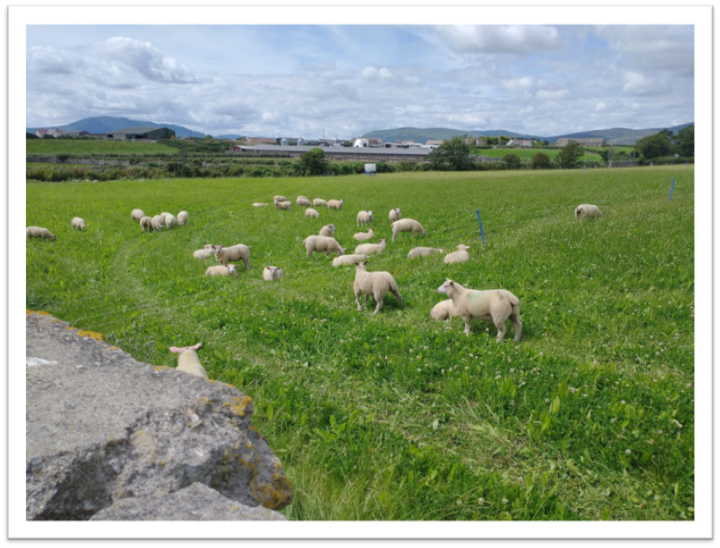
He says: "Previously, when we weaned lambs grass growth was often at its lowest and lambs stalled. We tried numerous things from boluses to vitamin drenches to no avail. The multi-species has solved the problem."
Despite last season's dry conditions, the multi-species maintained lamb growth at 300g/day, on average, and allowed them to be left on a consistent diet after weaning rather than moving them to red clover aftermaths.
Ram lambs are left entire. In previous seasons they failed to achieve decent fat covers, but last year they achieved fat classes of three or higher.
Fertiliser use has also fallen. After 100kg of 10:10:20 is applied early in the season to kickstart growth, the multi-species received no further inputs.
James adds: "We finished all lambs off forage last season without the need for concentrate. There was also some reduction in faecal egg counts."
Multi-species are not grazed tightly to aid the persistency of clover and herbs.
"The best advice I heard is that when you think you should move sheep, you should have moved them the day before. You want to keep lambs on a fresh bite," says James.
By year three, chicory and red clover will decline, after which the ley will revert to a cutting and grazing ley for cattle with fertiliser applied.
James sees multi-species as playing an important role in the future to help reduce days to slaughter and build soil organic matter in the sandy-loam soils. His goal is to ensure the small family farm remains viable for future generations: grow more forage, use it efficiently and better margins will follow.


