


Electric UTV's
Used by many, diesel UTVs have often been deemed as a noisy vehicle. Could electric UTVs offer ample capacity to meet the daily needs of a traditional farm business or diversification while delivering a quiet and more refined solution to the existing concept? Size and performance of batteries have improved significantly in recently years, although there are still significant differences in performance across the range of manufacturers and variations in operating conditions. Depending on the business requirements, an electric utility vehicle could prove the right solution.
Quadzilla E-UTV
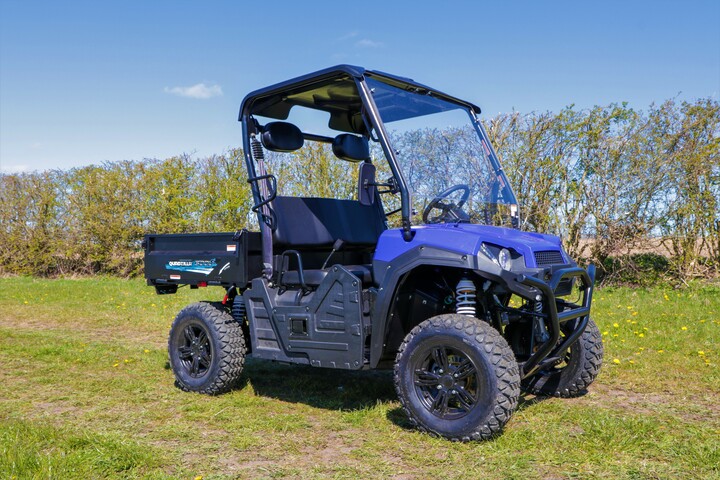
Qudzilla's offering to the electric UTV sector boasts a 9.7kW motor with 15Nm of torque. The manufacturer highlights a potential 100km (60 mile) range, although this is load and condition dependant. Like all EVs, charge times may vary depending on temperature, but the manufacturer states an eight hour charge time delivered though a standard three pin plug.
This fully road legal machine has a 40kph (25mph) top speed. Selectable transmission options include power and economy forward gears with a reverse.
Removing the drop sides on the tipping body allows for loading a euro pallet, with a payload of 400kg providing plenty of capacity. The suspension is based on a MacPherson front suspension system with a double a-arm providing an independent rear system.
Adequate for light offroad applications currently, the UTV comes in a two wheel drive format, with 24in x 8in-R12 in off-road tyres allowing for better traction.
The open sided canopy allows for easy access into the operator environment. Housed in the dashboard are the usual daily essentials; digital dials with speedometer, trip counter and clock. A waterproof bench seat layout allows space for two people. Other standard features include front mounted LED head lights and tail lights.
Quadzilla E-UTV:
• Dimensions: 2,700 x 1,420 x 1,870mm (LxWxH)
• Wheelbase: 1,805mm
• Weight: 442kg
• Cargo bed: 1.375 x 965mm (LxWxH)
• Payload: 400kg
Polaris XP Kinetic
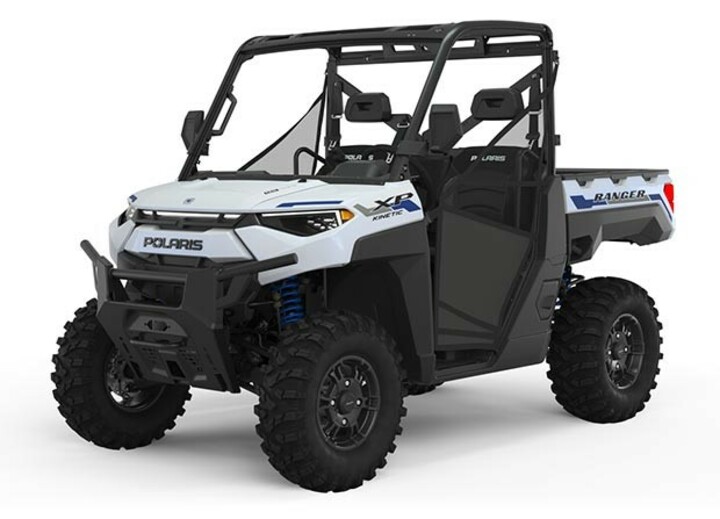
Currently available as pre order for September this year. The Polaris XP Kinetic has two variants, Premium and Ultimate, the three-seat variant available offers a format equivalent size and dimensions to the brand's Ranger diesel and XP1000. The Premium version comes with a 14.9kW lithium-ion battery with a claimed 70km (43 mile) range. Users requiring longer run times may wish to consider the Ultimate option, with a 29.8kW battery allowing a 130km (81 mile) potential range, says the manufacturer.
Each model produces 190Nm of torque, and the transmission allows for the selection of both high and low ranges, with an electronic forward and reverse enabling direction of travel.
Dual A-arm suspension front and rear allows for 254mm of travel, potentially improving ride comfort on varied terrain. The standard tyre fitting is 29in x 9in-R14 front and 29in x 11in-R14 rear.
Although the 2WD system is suitable for most applications, the Polaris utilises a its automated on-demand all-wheel drive system, engaging 4WD when needed. This vehicle has a payload of 677kg and a towing capacity of 1,134kg.
The vehicle can be specified with a three-seat option. A seven inch centre-mounted glove touch digital display delivers all the usual instrumentation including charge levels, speedometer and gear selection. GPS navigation and radio and an optional camera system can be delivered through the infotainment system.
Polaris XP Kinetic:
• Dimensions: 3,050 x 1,580 x 1,980mm (LxWxH)
• Wheelbase: 2,060mm
• Weight: 908kg
• Cargo bed: 933 x 1,378 x 317mm (LxWxH)
• Payload: 677kg
HiSun Sector 15Kw
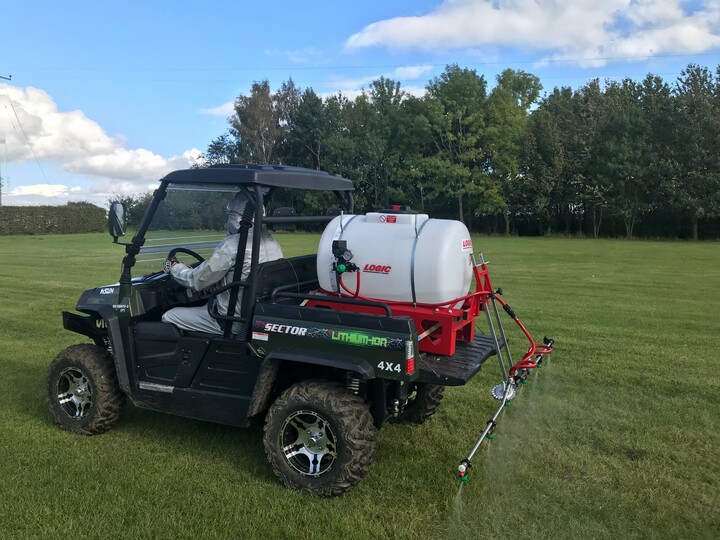
Manufacturer HiSun has five different variants within its electric UTV range, offering two, three and four seater options. Within the range, which is distributed by its agent Barrus, here its 15kW Sector model is comparative to others in this roundup.
HiSun claims longer run times and battery life expectancy with the built-in lithium-ion batteries; batteries require overnight charging to reach full capacity, with a claimed run time of eight hours and a range of up to 65km (40 miles), though the figure is not specific to this particular model.
This machine allows the operator to select two- or four-wheel drive depending on the terrain. Differential lock can be engaged through an electric control switch, and high and low gear ranges can be selected in both forward and reverse. Electric power steering comes as standard.
Front and rear suspension are both independent dual A-arm systems allowing the vehicle to traverse rough ground conditions, with all-terrain 27x9-14 tyres front and 27x11-14 tyres rear allowing for greater traction.
It is capable of towing 350kg and carrying a 227kg payload within its cargo bed.
Optional cab accessories include a canopy, side doors and front and rear wind shield to keep the operator out of the elements.
HiSun Sector 15kW:
• Dimensions: 3,010 x 1,585 x 2,020mm (LxWxH)
• Wheelbase: 1,950mm
• Cargo bed: 1,060 x 1,430 x 330mm (LxWxH)
• Payload: 227kg
Corvus Terrain EX4
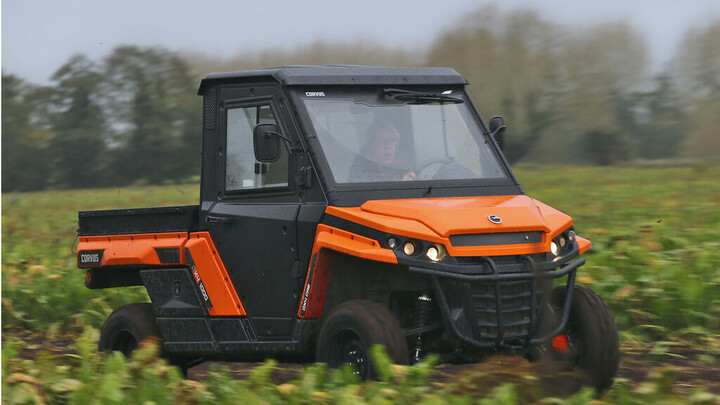
Corvus claims its new all-electric utility vehicle can deliver 100km (62 miles) of range, depending on conditions and power mode in use. Fully road legal, the vehicle comes with LED lights front and rear. Powered by a 15kWh lithium-ion battery, the Corvus is capable of delivering 150Nm of torque.
Payload capacity on this particular vehicle is 620kg. Variation in gear range selection, either high or low, can change the UTV's claimed towing capacity from 479kg to 755kg, respectively. Users can select two and four wheel drive, and the Terrain EX4 also comes with lockable rear differential.
The manufacturer has opted for an independent, double wishbone system for both front and rear suspension. This allows for 287mm of suspension arm travel, and Corvus says this leads to a reduction in shock over uneven terrain.
Directional control is selected though a forward and reverse gear lever, each capable of high and low range selection, with a maximum forward speed of 25kph (15mph) in low range and 40kph (25mph) in high range. Braking includes a double hydraulic piston on the front axle and hydraulic disc brakes on the rear.
There are two optional packages available; Pro EPS and Cab package. The Pro EPS includes Electronic Power Assisted Steering (EPS), front laminated windscreen with wash wiper, rear windscreen, interior rear-view mirror and under-seat storage, while the Cab package includes all of this plus doors, courtesy light and front luggage compartment.
Corvus Terrain EX4:
Dimensions: 3,414 x 1,656 x 1,973mm (LxWxH)
Wheelbase: 2,238mm
Weight: 897kg
Cargo bed: 1,340 x 1,202 x 300mm (LxWxH)
Payload: 620kg
John Deere Gator TE
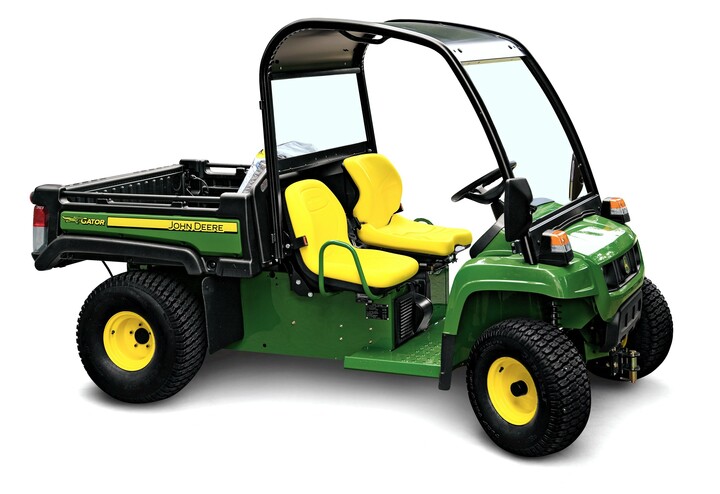
John Deere's two-wheel drive, electric TE Gator has a 48-volt battery system, allowing for a claimed seven- to eight-hour run time from a full charge. An electronic switch controls forward and reverse, with a single gear range for both. Maximum forward speed of the machine is 21kph (13mph) with a restricted reversing speed of 13kph (8mph).
Dynamic braking slows the vehicle via a motorised system when the operator stops using the accelerator. This system is also used in the battery regeneration system; when the vehicle travels faster than a maximum speed or dynamic braking is engaged, a percentage of energy is generated and returned to the battery.
The manufacturer claims an estimated 3 to 5 per cent return to the battery in a working day. Running alongside the dynamic braking system, the rear axle has a mechanical drum brake system.
The standard version comes in a two-seat open-top version, although there is a cab and windscreen option available. A battery charger is stored under the passenger seat; this has a built in temperature sensor, and the firm says this helps to improve battery charge and run times.
Available in both a manual and power assisted tipping option, the cargo bed has a 227kg payload capacity. Drop sides on the cargo bed can be removed to create a flat bed option for oversized goods. The UTV also has a 273kg towing capacity.
Suspension includes a front mounted single A-arm system with springs over shock absorbers, allowing for 127mm of travel, with the rear axle being fixed and solid. It is supplied as standard with turf tyres all round which are 22in x 9.5in-R10.4 (front) and 24in x 12in -R10 rear, although it may be possible to specify all-terrain tyres.
John Deere Gator TE:
Dimensions: 2,728 x 1,525 x 1,130mm (LxWxH)
Wheelbase: 1,940mm
Weight: 667kg
Cargo bed: 1,143 x 1,320 x 305mm (LxWxH)
Payload: 227kg