Forage for CH4nge project reveals interesting findings
Preliminary results of the Forage for CH4nge project were shared with farmers at a meeting in Leyburn, North Yorkshire
Farmers Guardian
28 January 2026
•
3 min read
Share
The aim of the Forage for CH4ange project was to improve sustainability and move towards net zero farming by measuring emissions and forage utilisation in Swaledale sheep compared to cross-bred sheep.
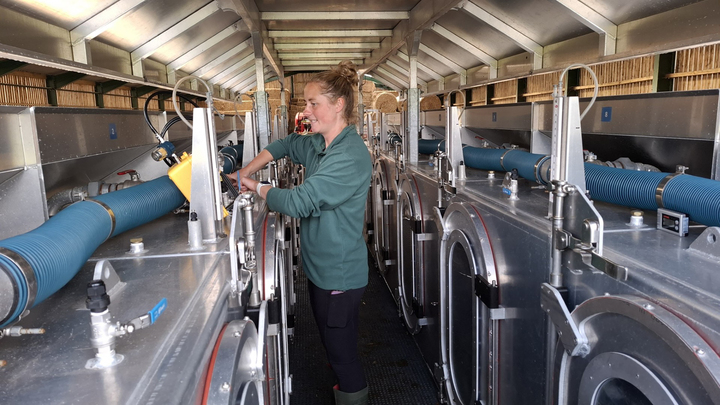
As part of the project, 120 ewes – a split of Swaledales and Texel cross Swaledales – were grazed on three vegetation types: improved grassland, species-rich grassland and moorland. Methane (CH₄) and carbon dioxide (CO₂) emissions were then measured using portable accumulation chambers (PACs). Animal liveweight and body condition scores were collected throughout the study.
Emissions from the sheep are measured in portable accumulation chambers
Key questions the project hoped to address were ‘does a native upland sheep produce lower emissions on forages they are adapted to than an improved breed type (cross-bred)?' and 'do some forage types produce lower emissions?'. Based in the Yorkshire Dales National Park, the project was funded by Innovate UK and led by local farmer Adrian Thornton-Berry, in collaboration with the UK Agri-Tech Centre, the Game and Wildlife Conservation Trust, SRUC, National Sheep Association (NSA) and the Yorkshire Agricultural Society. Nicola Noble, NSA project manager, said: "After almost a year and a half's work on this project, it was great to share the findings with local farmers."
Results showed that ewes of both breeds (Swaledale and Texel cross Swaledale), foraging on improved grassland – treated, seeded and/or fertilised – produced more methane per day, compared to those grazing on herb-rich natural grassland – natural and untreated for 30 years or moorland. Native Swaledale ewes also produced less carbon dioxide than cross-breds, even after adjusting for weight.
"An interesting part of the discussion was from Ellie Roberts, Niab forage specialist, who suggested there are natural methane inhibitors in the forages our sheep graze on, some of which specifically grow in the upland and moorland environments. For a predominantly extensive system that prides itself on high animal health and welfare, being able to utilise natural forages to help achieve net zero targets is exciting news."
This farmer-initiated project was funded by Defra under the Farming Innovation Programme: Research Starter Round 4, which is administered by Innovate UK as part of UK Research and Innovation.
Variation in emissions was influenced by breed and grazing type:
• Breed differences in methane were largely due to body size, but breed differences in CO₂ persist even after adjusting for weight (Swaledale producing less than cross-bred)
• Sheep grazing moorland or species-rich grassland produced 15% lower methane emissions than sheep grazing improved grassland
• Sheep grazing moorland produced 14% lower emissions of CO2 than sheep grazing improved or species-rich grassland
It is possible that some differences in emissions could be due to animals eating differing amounts of feed prior to emissions measurement. Individual feed intake could not be measured due to cost and practicality at grazing.
Understanding how forage type and breed affect greenhouse gas emissions can help farmers make informed decisions to reduce negative environmental impacts.
Key findings
• There was little evidence that breed affects methane emissions if body size is accounted for, but some evidence of slightly lower CO2 emissions from Swaledale than cross-bred sheep
• Compared to improved grassland, sheep grazing moorland produced lower emissions of both methane and CO2, while those grazing species-rich grassland produced lower emissions of methane
At a Ruminant Revival Collaboration day on-farm in West Lothian delegates heard how a changing climate requires a different approach to parasite control


 28 January 2026
•
3 min read
28 January 2026
•
3 min read


