


With some key clover-safe sprays set to disappear from the market this year, a new herbicide mix could provide farmers with an effective solution for controlling weeds in clover swards.
A new herbicide tank mix which can safely control docks in clover rich swards and help boost grassland productivity is being launched by Nufarm.
The new mix comprises of Agritox (MCPA) at 1.5 litres/ hectare and Squire Ultra (amidosulfuron) at 40g/ha and has been created for application on established grassland.
The mix has been designed as an alternative to the clover safe spray, CloverMaster (2,4-DB), which will cease to be available from autumn 2020.
This is usually applied with Squire Ultra.
Field trials carried out by Nufarm found that application of the new herbicide tank mix resulted in 95% control of a dock infestation which covered 20% of a field.
In addition, 80% control of chickweed was achieved.
The mix was applied to a four-year-old perennial ryegrass and white clover grazing ley at the end of August last year.
Brent Gibbon, agronomy manager for Nufarm assessed the field a month later.
He says: "We saw a 95% control of docks and a slight reduction in clover, which is to be expected because the Agritox label does state that clover may be checked, but it recovers by the following spring.
It is not 100% clover safe, but the clover that remained was healthy and growing," he says.
In fact the clover was found to recover to normal, six weeks after application in a separate, small plot trial carried out in Scotland.
Tips for getting effective weed control in established leys:
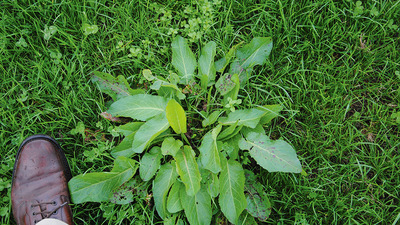
- Docks need to be at the leafy, rosette stage (in spring or autumn)
- Weeds need to be actively growing so the herbicide can be taken up by the plant. In very dry conditions, hold off spraying until the plant starts to grow again
- A minimum water volume of 200 litres/ha is needed to give good coverage of the weed leaf. Low drift, air inclusion nozzles are also recommended
- Apply herbicide a minimum of three weeks before cutting. On multi-cut systems where it may be difficult to leave this window, an autumn application may be preferable
Clover needs to have at least one trifoliate leaf before application.
Productivity
Mr Gibbon says farmers can be confident long-term clover production will be safeguarded, something which is vital considering clover's ability to fix up to 150kg N/ha/year.
At the same time, getting broadleaf weeds in check will help raise grassland productivity.
In fact, boosting production by just 1t DM/ha, can bring significant reward.
The new mix is also lower cost than the usual Clover Master and Squire Ultra mix applied at 3.3 litres/ha.
However, in order to achieve the maximum level of return on investment from herbicide application, Mr Gibbon stresses the importance of spraying weeds at the right stage.
The new mix can be applied to established grassland over one-year-old and is advised from April to September, through a conventional boom sprayer.
Only a seven-day grazing interval after application is required.
Where grass is to be cut for silage or hay, a three- to four-week interval is needed.
For new leys, Mr Gibbon advises using a clover safe mix of 2.5 litres of CloverMaster/ha plus 30g of Squire Ultra/ha.
Clover needs to have at least one trifoliate leaf before application.
Investing in weed control makes financial sense considering the potential to improve dry matter production per hectare.
Controlling a moderate 10% dock infestation can lead to a 1t DM/ha yield improvement from a typical 10tDM/ha sward.
This results in increased grazing availability and stocking rates which adds up to a 8:1 return on investment.