


The appearance of a truck with the abilities of a tractor, the Unimog has always attained an almost cult following, but how does it perform as a high-speed tractor replacement? Toby Whatley puts a 354hp U435 through its paces.
Originally developed in 1948 and manufactured by Mercedes Benz since 1951, the Unimog was designed as a multi-purpose truck/tractor hybrid which could offer the field performance of a tractor and the road-going prowess of a truck. In the almost 75 years since its launch, the Unimog has found its way into several specialist markets. Forestry, local authority maintenance and utility services are popular sectors, with buyers taking advantage of the products significant adaptability, enormous list of options and enviable off-road performance. Agriculture has remained relatively unengaged with the brand, with units being sold to specialist contractors, typically as dedicated spraying and mineral-spreading outfits.
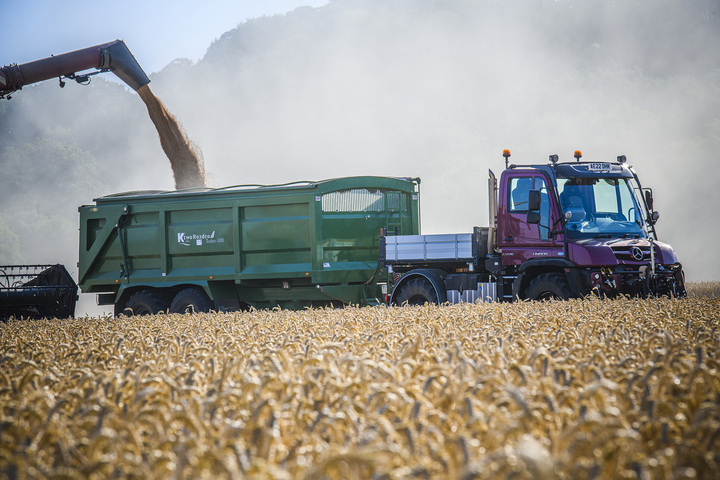
But with larger farms, covering greater travel distances and recently with even larger diesel bills, does the Unimog now offer a genuine rival to a high speed tractor? The specification for a machine is nearly as variable as the imagination of the buyer, which does pose a challenge in determining exactly what a tractor replacement machine should look like. However, key features, including a high road speed, full suspension, excellent forward visibility and low fuel consumption, are all features claimed by the manufacturer across the range.
Engine and transmission
Mounted under the cab, the engine and transmission is unsurprisingly an all-Mercedes affair. The six-cylinder, 7.7-litre OM 936 Bluetec engine pushes out a maximum of 354hp and 1,380Nm of torque. Drive on our test U435 was through an 8F/6R automatic transmission, with manual override. A maximum forward speed of 89km/h (55mph) was offered.
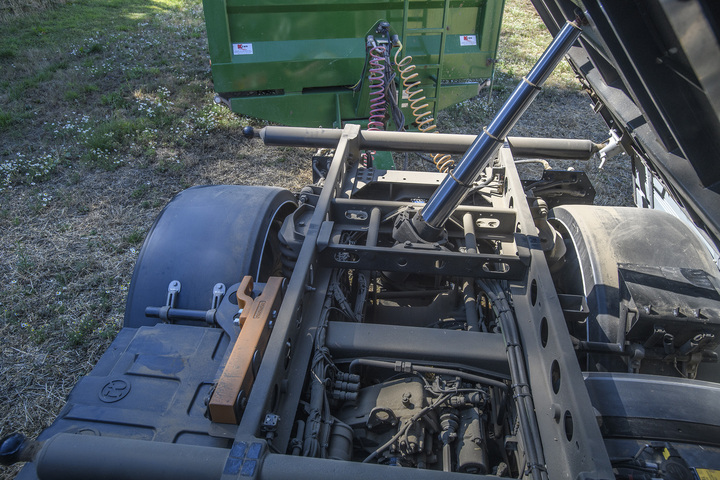
Unlike most tractors, the Unimog is permanently operated in four-wheel drive, with the addition of three differential locks in the front, rear and transfer box for when the going gets tough. Engagement of these is achieved with a rotary dial on the dashboard, with three stages of transmission lock-up depending on how bad driving conditions were.
Selecting the drive direction and transmission mode was operated through the right-hand stalk on the steering wheel. Although fairly unassuming, the rotary dial was twisted in the direction of travel and, for most tasks, the gearbox was left to its own devices operating in automatic. Pressing the end of the drive control changed the operation into manual, with the stalk paddle shifting up and down to move through the gear range.
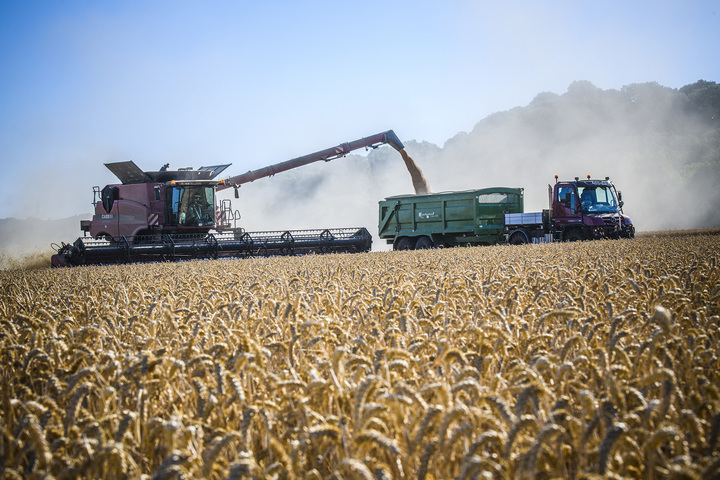
The main criticism of the transmission was the lack of ability to maintain a low speed. This was particularly noticeable when unloading from the combine on the move. A workaround solution to operate the drive in manual and maintain the engine speed with the electronic hand throttle did improve the control, however it was not a perfect solution. The manufacturer says an additional hydrostatic transmission can be offered alongside the eight-speed automatic to allow for precise, slow speeds up to a sprightly 50kph (31mph), which would in principle address this problem.
Despite the power reserves, acceleration was very conservative, regardless of the aggressiveness of the operator. Our test team initially was surprised by this, however once accustomed to driving style of the unit, pulling away from junctions, even when fully laden, was smooth and consistent. Gear changes and power delivery were dictated by the Unimog, not the operator. Although initially seemingly quite sluggish, once the vehicle was rolling, there was not a noticeable lack of power, even when approaching higher speeds, with the acceleration and road handling similar to a very large pickup, not a tractor.
Cab and controls
The cab frame is unique to the Unimog range, however many of the internal controls, steering wheel and dash have been lifted directly from the manufacturers truck offering. Fitment of the internal controls is practical and functional but lacks the refinement found on some tractors, particularly a higher horsepower version.
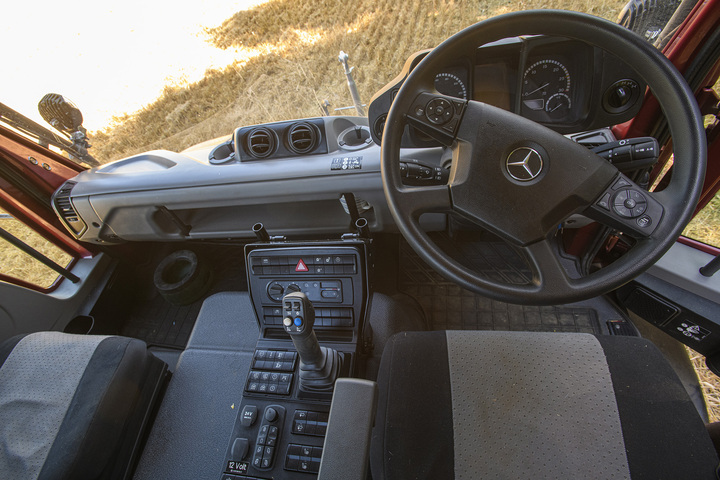
Mercedes highlights that many of the controls occupy the same sized fitment in the console, so can simply be unplugged and replaced, or fitted into a different position to suit the job at hand. The dashboards and steering wheel were both true HGV components, with the large steering wheel being fitted with the main controls for the digital dash, hands-free and cruise control.
Our test U435 was a permanent right-hand drive version, however certain models can be fitted with the optional Variopilot, which allows the complete steering wheel, dash and pedal box to be released and moved across the cab, creating a machine which is either right- or left-hand drive. Unfortunately, machines supplied with either Variopilot or permanent right-hand drive do not allow any pitch or rake adjustment of the steering column. This meant our test unit required the driver to stretch to use the full radius of the steering wheel, particularly when manoeuvring around the yard.
Occupying the position between the two seats, the centre console is the home of the main controls, including the hydraulics. Some of these took some user manual referencing to understand what the symbols were supposed to tell us. Unlike most tractors, where a seasoned operator can usually fathom out what the various controls did, the Unimog controls are either unique to itself or lifted directly from the trucking world.
All control direction and references for hydraulics and pto are related to the front of the machine, not the rear. This is a historic features and is due to the quantity of machines sold into markets using front-mounted tools, such as snow ploughs, blowers or wood chippers. Hydraulic control was achieved through a four-way joystick in the console. A combination of button presses activated different services, which once understood was very simple to use. An effective safety feature was the hydraulic isolation switch. This required reactivating each time the machine was started, which gave assurance that the exposed joystick to the drivers left arm could be switched off to prevent any unexpected movements.
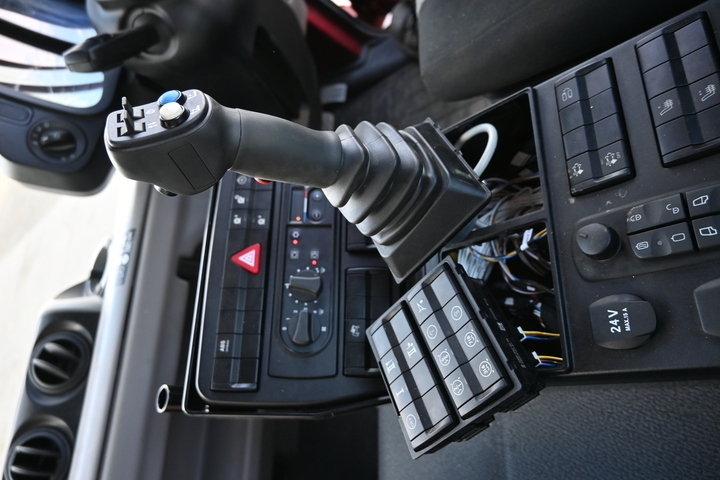
Although the hydraulic connections were colour co-ordinated with a dust-cap at the connection fitting, there were no colours shown in the cab, which did make the process of identifying which service related to the controls initially quite difficult. Seating and access were a wholly HGV affair, with a vertical climb using relatively narrow steps to clamber in. Handholds were, however, well placed. The air-suspended drivers seat included a height return memory, which lowered to allow move space to get in and out. Our test team had no complaints with the seating, which is clearly a very well-tested design suited to long hours of use.
A three-point seat belt mounted into the seat is another HGV crossover and, considering the vehicles road abilities, using it would be a sensible idea. Storage space was plentiful throughout, with a wide floor area plus several boxes and cup holders. Occupying the position of the rear view mirror, the camera screen was well placed and could be switched between the front and rear cameras on the vehicle. A nice feature was the storage space under the cab for a window squeegee and telescopic pole. This, combined with the dedicated hand-wash tank next to the coolant expansion tank, allowed the driver to wash their hands with warm water.
Linkage and hydraulics
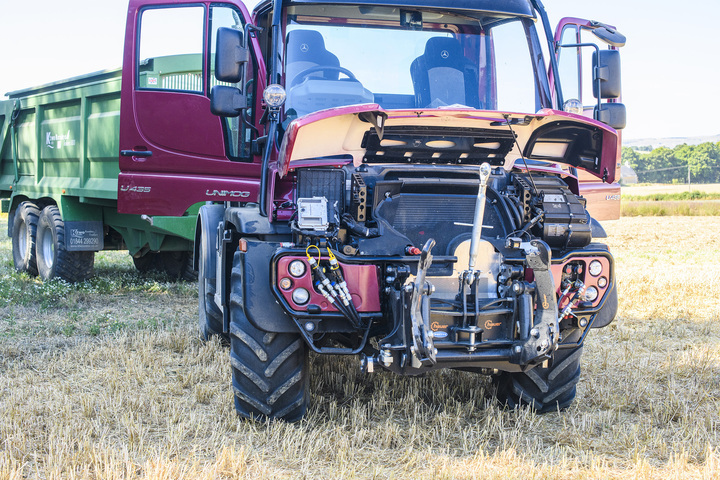
Unlike a conventional tractor, where the hydraulic spools are numbered or coloured in pairs, Mercedes numbers each hydraulic connection individually. This means machines use four spools, numbered one to eight, plus the addition of power beyond constant pumping. The rear hydraulic connectors were fairly basic in the fitting design and lacked an effective dust cover and drip collector.
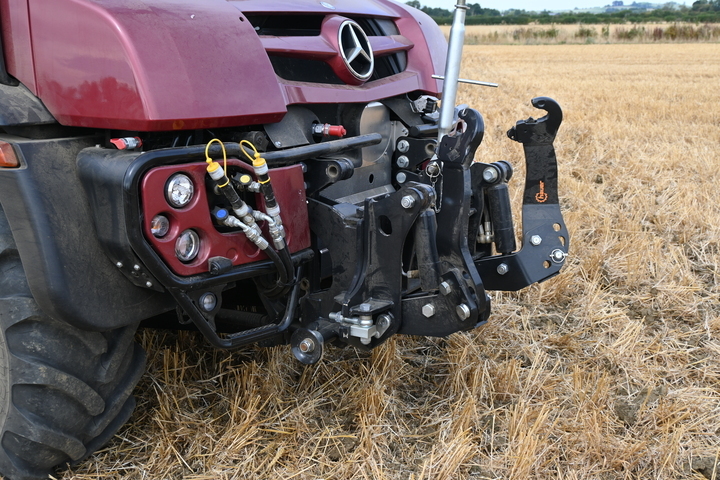
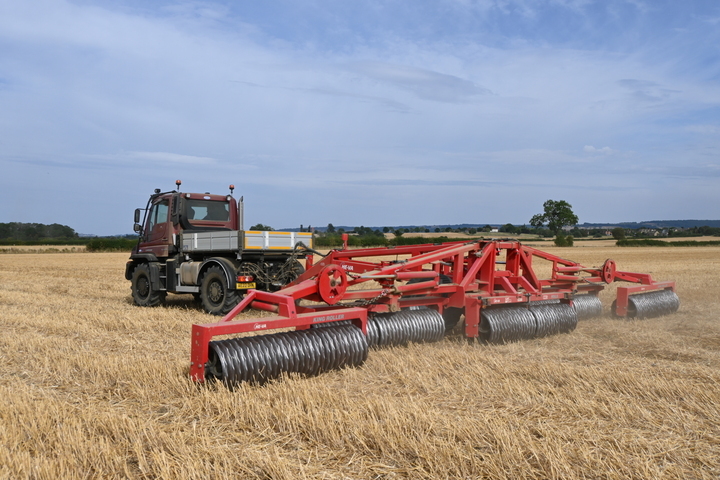
This was particularly noticeable with the connections mounted above the rear lights, where the excess oil ran down the lighting cluster. Mercedes says that leak-free, flat-face connectors are available as an option. Consistently with Unimog, everything is an option with no standard build for a machine. Our test machine was specified as an agricultural haulage machine and lacked a front or rear pto, and only had a front three-point linkage fitted. With the tasks we could effectively use the machine for during our test, this was not a major issue. However, it is worth noting that a rear linkage, if fitted, cannot be supplied with any draft control.
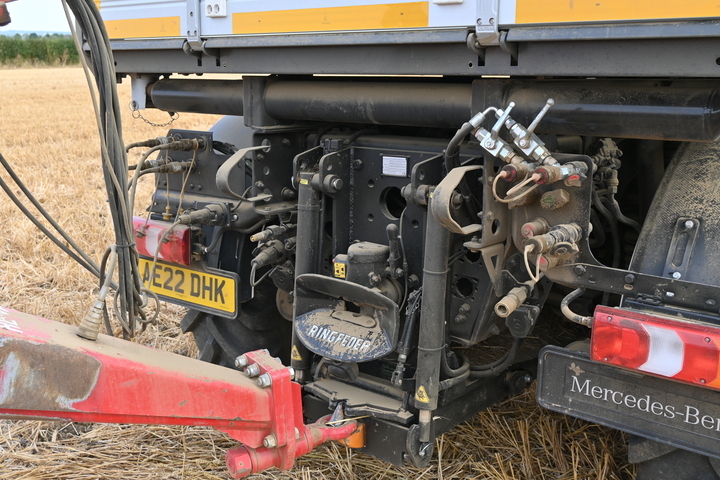
This effectively limited the unit to top work only, however the road speed and ride combined with the rear load space for rolls of net or twine could make the unit an attractive tug for a baler. Operating with conventional agricultural trailers, our U435 was supplied with a UK-sourced, pickup hitch, in addition to a Ringfeder automatic wagon hitch. The position of the pickup hitch did push the load further away from the rear axle and was difficult to hitch up, despite the camera system.
None of the test trailers or implements were suitable for the wagon hitch. However, if we were to invest in the Unimog, trailer upgrades to use this more practical and significantly safer attachment system would be a must. Air and hydraulic braking connections were sensibly mounted close to the hitch, but the ABS connection was a HGV specification 24-volt design and was incompatible during our test. The vehicle electrical system is a point of consideration in general. Operating at 24 volts throughout, users need to specify all 12-volt connections as options, from trailer ABS and lighting to auxiliary plugs in the cab for a phone charger.
Suspension and ride
Coil springs throughout generally gave a consistent ride on and off road, and when working in addition to the air suspension seat, the in-cab experience was smooth and very quiet, with a measured 73.2dB when running at full load. Considering the cab position above the engine and next to the exhaust, this was impressive.
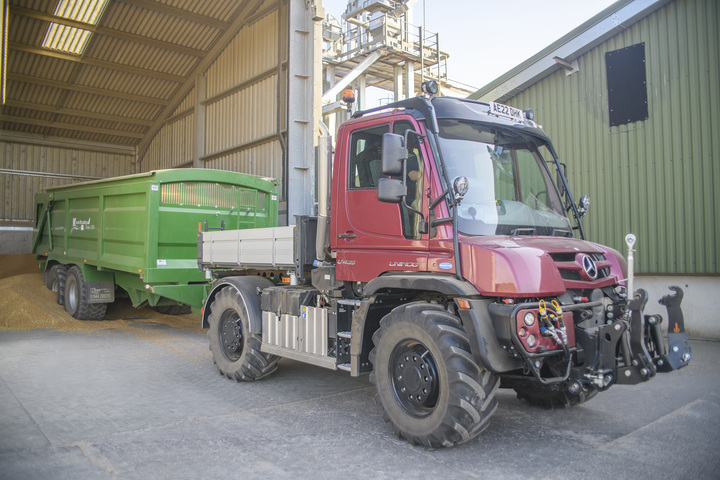
Fully laden, a combination of the pickup hitch position, drawbar weight and suspension design caused the machine to sit quite unevenly, with significant weight transfer off the front axle. Adding a weight pack to the front improved the machine balance. However, the manufacturer advises an optional hydropneumatics system for the rear axle is available, which allows automatic levelling under load and improved roll stabilisation - an option we would certainly choose.
Fuel consumption
The Unimog's fuel consumption, or lack of it, is a significant ace card for the brand. The manufacturer claims a 50% reduction in fuel usage when compared to an equivalent tractor. Running against a Fastrac 4220 with a near-identical 16-tonne trailer on an 18-mile round trip from combine to grain store, we recorded the Unimog using about 20% less fuel than the JCB.
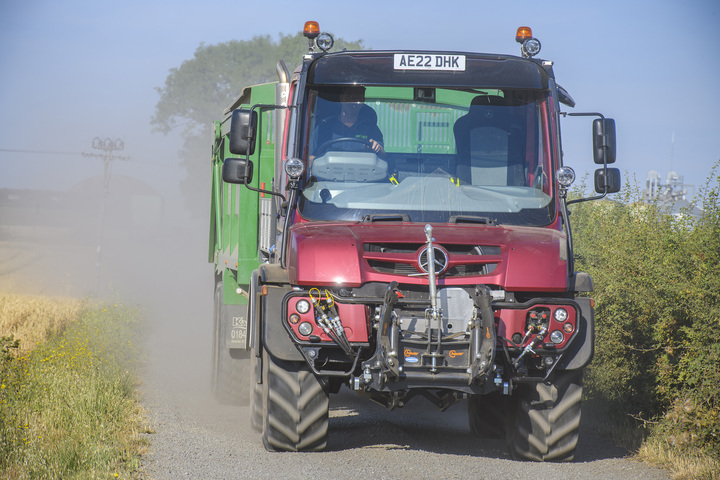
Impressive a reduction that this is, it is some way from the saving we were expecting, however the winding Cotswold roads did not allow the full road potential for the machine. Adding to that, the 235hp Fastrac pushes out almost 120hp less than the 354hp Unimog; clearly not quite a like-for-like comparison in terms of power.
We would expect any users running on much longer hauls, covering dual carriageways and major bypasses, to see a greater fuel reduction. This would largely be through the gearing of the drive, which dropped the engine back to less than 1,500rpm at higher speeds, and other on-highway specific features including the very effective two-stage exhaust brake.
Truck or tractor?
Our test U435 was registered as an agricultural vehicle and was subject to the regulations of a high-speed tractor. This allows a maximum road speed of 65kph (40mph) and a maximum gross weight of 31 tonnes. For comparison to a high-speed tractor, this was a good match, but users looking to use the full capabilities of the Unimog, including its maximum speed of 89kph (55mph) and gross weight of 44t, would need to register the vehicle as a HGV and operate using white diesel.
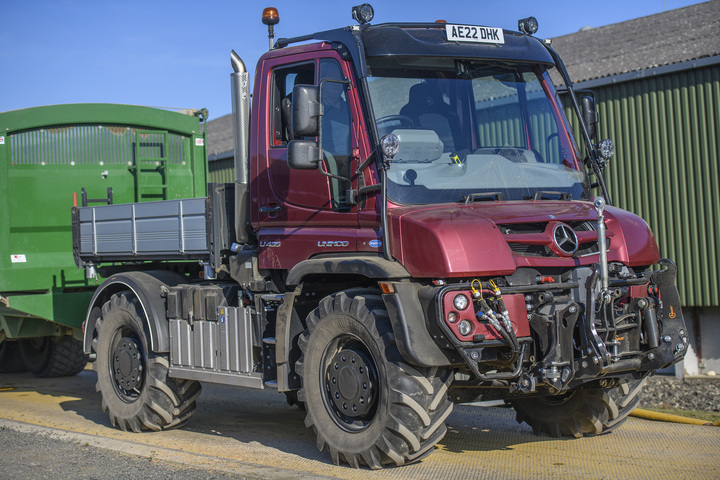
Daunting as this might sound, for some farms carrying out dedicated haulage, running the unit as a HGV could offer some advantages. It would allow the vehicle to operate on motorways, remove any concerns of legality with longer distance haulage using tractors, in addition to removing any grey areas between when a machine should, or should not, run on red diesel. Obvious challenges would be operating licensing for the driver and business, and tachograph rules. Echoing the complexity surrounding Unimog licensing, a specific page on the Driver and Vehicle Standards Agency website has been created to help buyers and operators understand their legal position and the Unimog registration options.
More information
gov.uk/government/publications/unimogs/unimogs
FG Verdict
We were left in no doubt that the Unimog has some serious go-anywhere capabilities and can be adapted for virtually anything its owner can think of, but is it a serious contender as a tractor replacement? Potentially yes, depending on the exact requirements of the business. For trailer haulage, plus the range of additional bodies which can be fitted to the back, it is difficult to beat in terms of capacity, speed, economy and, importantly, safety.
Our main concerns would be ensuring the buyer understands both their immediate needs and the needs of its next owner. If correctly specified for both, its initial use plus the needs of the second hand market, owners could take advantage of the brands enviously low depreciation and low running costs.However, if the business did require a machine to occasionally work as a dedicated tractor, the missing features, including draft control, direct visibility to the rear linkage and its hydraulic complexity, would demand the services of a conventional tractor and, in this area, the Unimog would struggle to deliver.
Test farm
Our test farm has a strong pedigree in running high-speed tractors. It covers 800 hectares of combinable cereals on land extending from the Vale of Evesham into the Cotswolds.
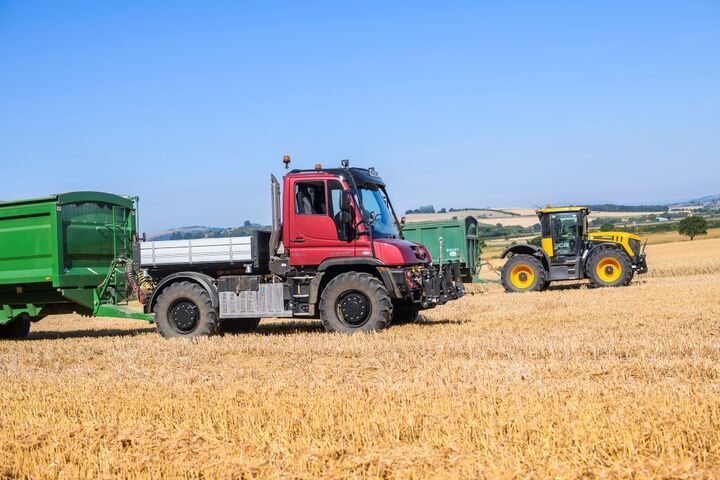
The business previously ran Fastracs in the early 2000s, with a return to the brand when a 4220 was purchased in 2020. The combination of farm size and quantity of road use gave a good setting to utilise the Unimog and see how well a machine designed for regular haulage work would perform.
Like and Gripes
+ Forward Visibility
+ Exhaust braking system
+ Additional load space
+ Ride, cab size and operator position
+ Fuel consumption
+ Range of options and adaptions
- Soft rear suspension
- Visibility of rear hitch
- Hydraulic controls and complexity
- Suitability for all farm tasks
- Lack of steering wheel adjustment
- Lack of compatibility with some implements and trailer
Unimog U435 specifications
- Engine: Mercedes OM 936 7.7-litre, six-cylinder
- Power: 354hp
- Torque 1,380Nm
- Transmission: 8F/6R Automatic plus manual override
- Speed: 89kph (55mph)
- Gross weight: 44 tonnes
- Brakes: Disc all-round, plus exhaust braking
- Turning circle: 14.3m
- Weight (as tested): 7,760kg
- Tyres: 445/70 R24
- Price (as tested): 170,000