



Ask any farmer or fencing contractor what frustrates them most about timber posts and the answer is predictable: they don't last. In damp ground — which covers most of the UK — a standard timber post can start to rot within a decade. Factor in splitting, livestock pressure and the time spent replacing failed sections, and the true cost of timber fencing is far higher than what goes on the original invoice.
It is a problem that has been getting worse. Timber prices have risen sharply in recent years, contractor availability is stretched, and many farmers are being forced to prioritise which boundaries get attention and which get left. For livestock enterprises in particular, fencing is not optional — and a boundary that fails mid-season creates problems that go well beyond the cost of a new post.

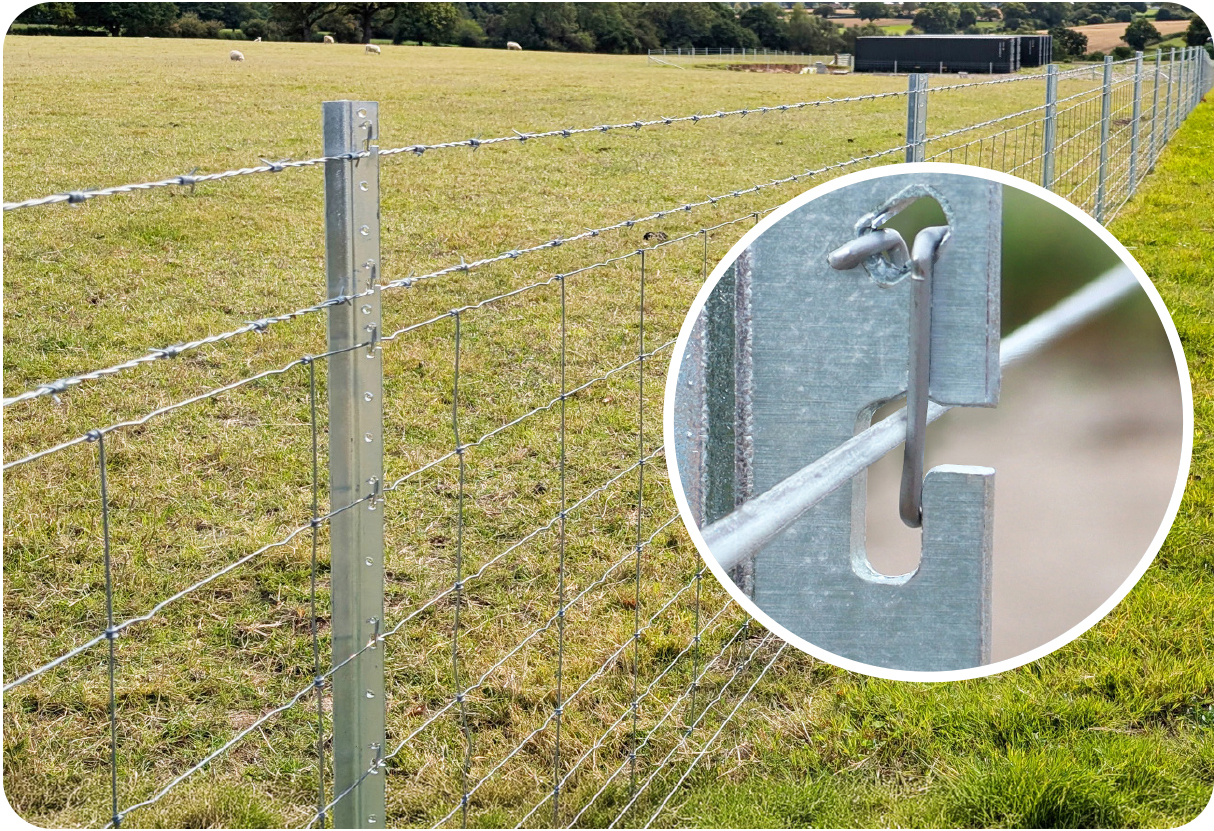
It was exactly this pressure that led fencing contractor Lloyd Fencing to trial a steel-based alternative. QuickClip, a complete steel fence post system developed by Shropshire manufacturer A. Perry Ltd, is designed to replace traditional timber intermediate posts with high tensile steel that can be driven directly into the ground by hand — no post knocker or heavy machinery required.
"Using QuickClip made the job significantly easier, as the posts can be knocked in by hand without the need for heavy machinery," says Lloyd Fencing. "The landowner is delighted knowing the fence will never need replacing."
The system's intermediate posts are formed from high tensile steel and extruded as a single piece with a reinforced angled plate, eliminating the weak points associated with welded alternatives. They are hot-dip galvanised to BS EN ISO 1461 and backed by a 40-year guarantee. An integrated clip system enables rapid wire attachment on site, cutting installation time without the need for additional fittings.
Unlike timber, the posts will not rot, split or weaken in the ground. The system is designed to perform consistently across all ground types, from soft soils to hard terrain, and requires zero maintenance once installed. For farmers replacing fencing on a rolling cycle, the long-term arithmetic is hard to ignore: one installation at a higher upfront cost versus three or four timber replacements over the same period.
A. Perry Ltd, the company behind QuickClip, is a fourth-generation, family-owned British manufacturer with more than a century of heritage in the agricultural sector. Managing Director Guy Perry says the system was developed in direct response to what contractors and farmers were asking for.
"QuickClip has been developed to solve real challenges faced by fencing professionals," he says. "After more than two years of design, testing and refinement, we're proud to deliver a system that outperforms timber alternatives in durability and installation time, with no negative impact on the environment."
A. Perry shall be presenting the QuickClip fencing system at many regional agricultural shows across the country, including the Devon County Show, the Royal Welsh Show and the NSA Sheep Event.
QuickClip is now available through a growing network of agricultural merchants across the UK, inlcuding Mole Valley Farmers.


