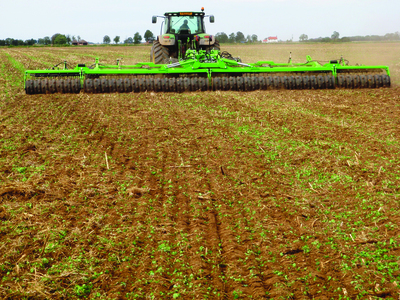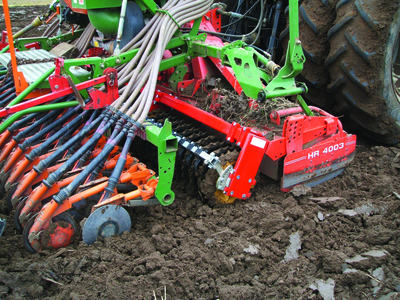


With a vast range of rollers on the market, how do you choose when buying a cultivator?
Jane Carley gets advice from manufacturers and looks at specialist designs.
While most manufacturers offer a huge range of roller options, choosing a specific roller is the best approach only where soils are consistent across the farm.
That is the view of Kverneland tillage product specialist Adam Burt, who says: "Soil types vary so much on UK farms, and even within fields, that we are looking for a more universal roller, which can work in different conditions or produce different results.
"The heavy rain events in this country means that the surface may also need to be weatherproof."
Kverneland offers two packers designed to give this flexibility.
"The Actipack roller is a shouldered ring press, but also features a knife section between each ring. The shoulders break down heavy soils and the knives than be in or out of work, depending on the finish required."
When breaking soils down to produce a seedbed, putting the knives in work gives an additional cultivating effect and acts like a levelling board to move soil, producing a fine finish ready for drilling.
However, where the seedbed is required to overwinter, the knives are taken out of work.
Mr Burt says: "Using the rings alone gives a corrugated effect which prevents the surface breaking down and possibly capping, allowing it to withstand the weather."
A new addition to Kverneland's armoury came last year with the acquisition of Great Plains, which had pioneered the DD press.
"This features large shouldered rings. In lighter soils the packer sits on this shoulder, rather than dropping down into the soil.
"However, due to the shape of the shoulder and the ring spacing, the DD press can also work through to depth, penetrating to the level of the tines. This again gives a corrugated effect which allows the soil to dry out more quickly."
Initially available on the former Great Plains DTX and Flatliner subsoilers, the DD press will ultimately be rolled out across the Kverneland cultivator range.
CONSOLIDATION
Variable soil types across most farms have different consolidation requirements and most buyers may need to compromise between their heaviest and lightest land to get a universal roller, suggests Amazone brand manager Simon Brown.
He says: "There is the benefit most of our packers are easy to swap, so it is possible to have a couple of options and switch them over, or to use the cultivator without a packer at all, especially as they are not needed for depth control."
When specifying rollers, buyers should consider soil type first, followed by the working depth of the implement, with surface finish as the least important criteria, says Kuhn Farm Machinery's non-inversion machinery specialist Will Waterer.
"The effect of the packer below the surface is more important. Which is why we will always dig down and look at how the soil profile is consolidated when demonstrating a cultivator," he says.
One advantage buyers now have is the wider availability of packers across the range of Kuhn cultivators, he adds.
Aqueel
The Aqueel Lite is a segmented roller originally designed by a British potato grower for use in a wide range of crops. It creates indentations in cultivated soils which hold water and also reduce wind speed at the surface, protecting germinating crops.
Chris Lane, founder of supplier Tillso, explains: "The Aqueel uses a polyurethane material which allows the tooth to flex as it goes into the soil avoiding smearing.
"We generally sell the Aqueel to farms using irrigation systems to reduce run-off and avoid environmental risks. It can decrease the total amount of water required to produce a crop in an irrigation system."
Tillso has developed the Flexi-Till (FT) flexible rubber roller, which works in a similar way but produces fewer indentations, with a shallow saucer shape.
The FT roller runs with a flat contact patch on stubbles, giving consolidation on non-cultivated soil, making it suitable to use directly after harvest to create a stale seedbed.
It can also be used after drilling to consolidate the seeding zone and can be used sooner after drilling than a conventional roller, conserving moisture.
"It is made of rubber so is more durable and can take higher loadings than the Aqueel and will work behind subsoilers and cultivators," says Mr Lane.
Both rollers are commonly sold for retrofitting to' existing cultivators. The FT roller is also fitted to Tillso's Rake & Roll stubble cultivator and Advantage subsoiler.
Guttler
Wox Agri Services supplies the Guttler range of prisma rollers, first developed by the German manufacturer in 1976 and sold as retrofits or replacements and in the company's range of wholegoods.
They are designed with ‘golden hooves', multiple points in the roller profile to give the same effect as a flock of sheep passing over the land - a loose, crumbled surface with consolidation at depth.
Wox Agri Services founder Geoffrey Wox says: "This gives a good capillary action which encourages moisture retention, while minimising soil losses on lighter land."
While the cast ring versions are used in front presses or heavy rollers to deliver active working weight, lighter Synthetic Ultra models are preferred for a packing action behind implements such as cultivators and power harrows, says Mr Wox.
"The synthetic rollers are 50% lighter and can create the loose top and firm depth even in sticky, wet soils. On a mounted machine, this makes a significant difference in lift capacity requirement and also minimises soil damage at the headland."
Synthetic rings can also be specified for wider front-mounted implements, working behind two rows of tines to break clods and produce a fine seedbed for maize and sugar beet in the spring and oilseed rape in autumn.
"We do a lot of replacements. We are often approached to replace the packer on a power harrow, for example, to help run cleaner in poor conditions. Prices start from £1,000/metre, depending on the complexity of the fitment," says Mr Wox.