with Boehringer Ingleheim
Milk Watch - September 2011
Ahead of housing their stock this winter, our Milk Watch farmers turn their attention to husbandry, ventilation and disease management.
Improving ventilation to keep disease at bay
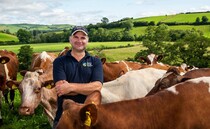
September sees milk come into full production on Higher Ashton Farm, near Dorchester, Dorset, where Milk Watch farmer Sam Foot says three of the farm’s four herds have been moved back on to three-times-a-day milking. Production has increased in response by an average 3.7 litres per cow per day.
Numbers in the calf sheds are beginning to swell, focussing increasing attention on husbandry practices which will ensure health does not suffer as more young animals come under one roof.
“Like most farmers, we use a variety of old dairy buildings for our calves, so we’ve had to adapt them as best we can to improve their suitability,” says Mr Foot.
Ventilation is always important for the prevention of respiratory and other diseases, and has been improved in some areas by the partial removal of Yorkshire boarding and enlarging outlets in roof ridges.
Smoke tests
“We’ve also carried out smoke tests in our buildings to check their air flow. Our overall aim is to avoid low-level draughts, but to keep air moving,” says Mr Foot.
“Our main aim is to avoid any pneumonia and, apart from keeping the ventilation right, our main preventative practice is a routine intranasal vaccination against the main pneumonia pathogens.
“Some cases are inevitable, which we’ll act on quickly to minimise any spread, and use both an antibiotic to knock out the disease and a non-steroidal anti-inflammatory drug [NSAID] to make the calf feel better and reduce inflammation.”
“If we look back at the affected calves’ records, we invariably find something went wrong at an earlier stage, whether that was scouring or perhaps just a difficult calving, and at the root of this is often inadequate colostrum,” he says.
However, the first batch of 35 calves to go right through the system this year has been reassuringly free from disease and calf rearer Rory McIlroy was praised for their ‘fantastic performance’.
A further boost to morale has come through an increased September milk price, which Mr Foot says is a reflection of the way Milk Link is working.
“We’ve had some fairly tough years with ongoing capital investments, but now the members who have stuck with the business are starting to reap the rewards,” he says.
“There have been some shrewd acquisitions, including the Taw Valley Creamery, and now we’re seeing more and more of their products on the shelves.”
Reducing stress to improve herd’s health
The calving routine is running smoothly at Huddlestone Farm, near Steyning, West Sussex, where Milk Watch farmer Tim Gue takes pride in rearing his young dairy calves.
A new 120-space calf unit comes into full use this year. The first of its two buildings is already almost at capacity and the second planned to fill as autumn calving progresses.
“Our aim has been to give them an environment in which they can thrive,” says Mr Gue, who ensures every calf is routinely tubed with at least six litres of its own mother’s colostrum before it enters the unit. They will go into a group of 15 and be fed by a computerised feeder, and will not come out of this group until they are turned out next spring,” he says.
The aim is to remove the stress associated with moving and mixing to reduce disease and use fewer antibiotics.
A new vaccination routine has been designed to minimise handling and stress. Immunisation against a range of infectious respiratory diseases is carried out in one process, where practicable.
Shed design
Ventilation has been a top priority in the unit’s design. Each shed’s features include a computerised curtain which responds to rain, temperature and wind, a gale-breaker screen along the facing wall and a transparent ‘lighting ridge’ designed to stimulate the movement of air through the roof through natural convection. It’s early days, but it seems to be working well,” says Mr Gue. “There’s no hint of ammonia and I haven’t yet heard a single calf cough.”
However, three off-colour calves have been treated for pneumonia using the farm’s usual ‘swift treatment’ response to any hint of disease.
“If anything isn’t feeding, or even just feeding slowly, I will take its temperature and treat anything higher than 39.6degC,” says Mr Gue. “I’ll use both an antibiotic and a non-steroidal anti-inflammatory drug [NSAID] and find if I have treated something in the morning, it’s usually up to full speed by the afternoon.”
Although prepared to acknowledge his own role in maintaining the health of his youngstock, Mr Gue is keen to pass praise on to other members of his team.
“Our two young dairy herd managers, Adam and Ant, have just been awarded ‘LKL Team of the Year’, and should be really proud of this achievement,” he says.
Also keen to recognise success of another winner, he says: “Tom King from Vortex Holsteins is such a deserving winner of the RABDF/NMR Gold Cup, presented at the Dairy Event last week. I’d like to pass my congratulations on to him too.”
A word from Boehringer

By Laura Randall,
AS the nights draw in and the days become shorter, it can only mean one thing - a calf pneumonia outbreak is around the corner.
Pneumonia represents one of the greatest health risks to calves in most rearing systems because the basic requirements for managing youngstock exposes them to risk factors for developing pneumonia.
Pneumonia can reduce a calf’s daily liveweight gain and compromise its immune system, leaving it susceptible to further infection and lung damage, which can reduce its lifespan.
Pneumonia in calves is caused by infectious agents which invade and damage lung tissue. These agents include mycoplasmas, viruses such as bovine respiratory syncitial disease (RSV), parainfluenza (PI3) and infectious bovine rhinotracheitis (IBR), and a range of bacteria.
In many situations it is not practical to isolate the agents responsible, so a treatment plan should take this into account to give the best chance of returning calves back to full health as rapidly as possible.
Ventilation is a critical risk factor. However, as a high incidence of pneumonia can occur in modern well-ventilated, purpose-built sheds and a low incidence in small poorly ventilated boxes,this alone is not the only important risk factor. Humidity, stocking density, stress and general calf health are all contributing factors.
By spotting calves which are affected quickly, you can give appropriate medicines as soon as possible. A treatment protocol might include:
- Anti-inflammatory: Important in reducing inflammation associated with pneumonia, speeding up recovery and reducing long-term lung damage. This helps the calf recover, whatever the causal agent. NSAIDs also reduce the temperature of pyrexic calves (too hot) to make them feel better, helping their appetite.
- Antibiotic: A broad spectrum antibiotic may be used to cover as many of the potential causes of infection, and one that gets to the lungs quickly and effectively. Antibiotics only help if there are bacteria contributing to the disease.
- Vaccination: It is sensible to know the cause of infection on a farm for vaccination to be most effective. However, there can be benefits from using some vaccines without knowing the cause because of the type of antibody they produce.Talk to your vet about the best option for your farm.
In addition to these main treatments for calf pneumonia, remember a bit of TLC can make a big difference.
Always provide enough to eat and drink, encourage calves to lie on both sides to reduce fluid collecting on one side of their chest. Keep bedding fresh underneath them to keep them clean, dry and comfortable.
Think about the calves’ environment - if there are only one or two calves affected, keep them separate to reduce the infection spreading, but ensure the environment where they are kept is right for them - not too hot or cold, draughty or stuffy.

Farmers Guardian newsletters
Get the best of Farmers Guardian delivered straight to your inbox. Click here to sign-up today
-
General news and breaking news alerts
Minimum weekly delivery -
Livestock, arable, dairy and young farmers
news and features
Monthly delivery


By unlocking the export potential China offers the pig industry, not to mention the red meat sector as a whole, we could gain entry into a marketplace which comprises a fifth of the world’s population.