Livestock deaths blamed on 'big cat'
LIVESTOCK farmers were on alert this week after a series of savage attacks on livestock in Pembrokeshire and the North of England, raising fears there are big cats on the prowl.
The Welsh Assembly Government (WAG) has launched an investigation into the Pembrokeshire attacks after it also received reports of sightings of a big cat.
Farmers in Princes Gate claimed there have been sightings of a big cat in the area which is believed to be around 4ft long, with a curved thick tail.
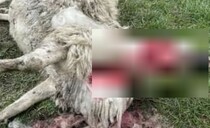
A paw print found near the latest dead animal is also being analysed after farmer Malcolm MacPhee reported finding one of his best Suffolk pedigree ewes ‘torn to shreds’.
Dairy farmer John Mathias said he also found one of his calves dead with similar injuries and claims to have seen the big cat on several occasions.
Pembrokeshire Council said one of its senior animal health officers has visited Great Redford Farm, near Narberth, and examined a carcase.
A spokesperson for WAG said: “We have received reports of sightings of big cats in the Narberth area of Pembrokeshire, together with alleged attacks on sheep.
“Where there is a suspicion that an animal was attacked by a non-native animal we consider evidence including post mortems, video footage, photographs and casts of foot prints.”
In a separate incident in North Yorkshire this week, police were called to Buddle House Farm near Kirby Hill after a farmer found a carcass of a sheep, stripped to the bone.
A second sheep was found savaged on a farm just 50 miles from Kirby Hill, and investigators fear the two could be linked.
Police have launched an investigation into the incident, taking DNA tests to determine what killed the sheep and said they have not ruled out the possibility of a big cat attack.
Farmers Guardian newsletters
Get the best of Farmers Guardian delivered straight to your inbox. Click here to sign-up today
-
General news and breaking news alerts
Minimum weekly delivery -
Livestock, arable, dairy and young farmers
news and features
Monthly delivery


There is a well known saying, 'no pain, no gain' and that will be ringing true in the minds of Milk Link’s 1,600 producers, who are on the brink of reaping just reward for 12 years of loyalty and investment.
Readers' comments (6)
Anonymous | 30 November 2010 5:06 pm
I am suprised the police are taking such an interest in the Yorkshire attack. I recently had a savage attack on my flock of rare breed sheep in Northamptonshire leaving 4 dead and 9 injured. The police called on two local farms and then closed the file, seemingly uninterested. I now cannot insure my sheep for 'worrying' which is what this is classed as because the animal (s) which caused the attack were not caught.
Unsuitable or offensive? Report this comment
Marches Farmer | 30 November 2010 5:15 pm
I saw a black panther (actually a melanistic puma) when I opened the curtains very early one morning this Spring. It was about 300 yards away, on a field of short grass, a big longer than a ewe looks at that distance and unmistakably a big cat. We're in an area with lots of neglected small woods with roe deer and muntjac.
Unsuitable or offensive? Report this comment
may | 30 November 2010 6:17 pm
where did thay come from
Unsuitable or offensive? Report this comment
Mrs Felicity Corry | 30 November 2010 9:49 pm
I have had attacks on our flock over 10 years from a creature that has deep red eyes when seen by torchlight. Seen at lambing time between midnight and 4 a.m. terrifies the sheep. Seen by dog walkers, a car full of tourists, C.A.A. employees, we think these pumas are breeding heard calling for a mate.
Unsuitable or offensive? Report this comment
bigcatdetective | 1 December 2010 9:18 am
The reports i have from country professionals that have had bigcats in the lamp is that they have virtually the same orangy-yellow colour as foxes but slightly different to the experienced eye,move differently and have slightly wider spacing.Sounds i have heard are unearthly screeching,like a tame cat only deeper and very much louder and others have heard a typical bigcat roar....
Unsuitable or offensive? Report this comment
Amy | 2 December 2010 3:46 pm
To May
They probably came from people who used to keep them as pets. When the law was changed so that you needed a special licence to keep big cats a lot were just released by their owners into the wild. Theres plenty of food to sustain them and places for them to hide. Some probably also came from circuses having escaped
Unsuitable or offensive? Report this comment