with Boehringer Ingelheim
Milk Watch - October 2011
Both our Milk Watch farmers have made changes to their cubicle housing in a bid to reduce mastitis incidence. We find out what they have been up to over the last month.
Dual benefits from milled straw bedding
Our Milk Watch farmer, Sam Foot, says he has seen the light when it comes to bedding cows in cubicles and believes the answer lies in milled straw.
Across the four herds at Higher Ashton Farm, near Dorchester, he describes making the switch to this bedding as ‘revolutionary’ and says since sand is not an option, it is the next best thing he knows for keeping mastitis and cell counts firmly under control.
As the herds approach their long period of winter housing, he feels confident the system provides them with as good an environment as he could create, and he has saved significant cost into the bargain.
“We changed to this system three years ago and have cut our straw usage in half,” he says. “We also have auto-scrapers, and find at the lagoon end, everything flows rather than builds up, and similarly, when the cow reverses out of her cubicle, the bedding parts like the Red Sea, instead of being dragged into the passage.”
Using the farm’s own mobile mill mixer and chopping straw to around 2-3cm, it is used on top of mattresses and is said to be far more absorbent than the long straw it replaced.
Scraped
With the back end of cubicles scraped out during each milking and hydrated lime added daily, he says there’s no need to add milled straw more than every other day.
The result is an exceptionally clean situation for the cows, reflected in outstanding udder health, with the best herd (the 150-head Banyard Dairy) running at 12 cases of mastitis since January 1, 2011. Meanwhile, cell counts across all four herds now stand at 120-130.
“It’s been amazing to see mastitis cases so low at Banyard,” says Mr Foot. “The unit is on the top of a hill and there’s always air flow there. It also has fewer fly problems than the other three in summer, which are all in the valley.”
Insisting the type of cow being bred is also important, he chooses bulls with low somatic cell count indexes and closely monitors their performance.
“We keep a chart on the wall and if there’s a trend in a particular bull’s breeding pattern it soon becomes obvious,” he says. “You often find that if you took one or two sires out of the system, you would make big improvements.”
To this effect, he recently sold 60 straws of a ‘well known bull’ from his flask, remarking, “We just can’t tolerate those that get mastitis.”
Looking with optimism
towards the winter, he says he is delighted with how cows are milking. “At our Westbrook herd we’re now on average 131 days in milk and are selling 41 litres per cow per day, which is a figure we haven’t quite reached before,” he says.
Commending the whole team for making it happen, he has additional praise for near neighbour and contracting customer, stating: “We were delighted to see Tom King [Vortex Holsteins] win the Gold Cup this year for his near-perfect operation.”
Aim is now to pull down mastitis cases
The team at Huddlestone Farm near Steyning, West Sussex, has scarcely paused for breath over the past two months, with autumn cultivations followed by winter wheat drilling, maize harvest and a complete refit of the cubicle house.
With all now prepared for winter, Milk Watch farmer Tim Gue hopes the refurbished cubicles will improve cow comfort and reduce mastitis and lameness.
“The mattresses were 10 years old and had gone like concrete, so they all came out for a good shake up, and when they went back in, they had 20mm of latex foam and new covers put on top,” he says.
“Now if we go into the shed once they’ve finished eating after milking, we find the lying rates to be phenomenal compared with before. The last time I looked, every one bar two of the 180 in the group were either lying or eating,” he says.
With cell counts regularly hovering around the 115 mark, he says the main drive now is to pull down mastitis. Apart from strict cleanliness and preventative routines, rigid treatment protocols are adhered to when a case arises, involving an intramammary antibiotic chosen specifically to match the severity and type of infection.
Knock back
“We’ve got a lot of fresh cows at the moment so we’re at peak risk,” says Mr Gue. “We’ll knock back high cell count cases straight away as if we don’t, it’s inevitable they’ll lead to mastitis two or three weeks later.”
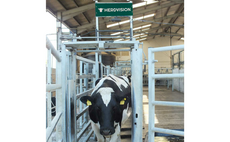
Preventative treatments are also focused on foot care right now, with a second-hand crush having just been purchased for foot trimming.
“It’s all-singing and dancing, and although it picks up the cow, it doesn’t turn her on her side, but allows her foot to be brought up to just the right height.
“This is kinder to the cow and the operator, and I noticed our foot trimmer, Luke Donald, trying it out at the crack of dawn today.
“Making things easier to do is one of our golden rules, as when things are too difficult they’re far less likely to be done,” he says.
A word from Boehringer

By Laura Randall, veterinary adviser
WITH the mastitis-causing pathogen, Strep.uberis, commonly found in the environment, it is important to look at ways of preventing infection occurring and also prompt treatment.
The pathogen can cause significant damage to the udder and result in a cow being off colour for several days.
The bacteria live in faeces so are present in bedding and grazing areas, particularly where cows congregate.
The infection is often picked up in the dry period and around calving, particularly when straw is used as a bedding material.
Milk clots
Cows with mastitis caused by Strep.uberis often have flakes or clots in their milk, some swelling and pain in the udder, an increase in body temperature and a raised somatic cell count.
Preventing the infection involves using clean, dry bedding and avoiding areas of pasture which are overused, and ensuring effective dry cow therapy is used within the herd.
Disinfection
In the milking parlour, pre-dip and post-dip teat disinfection help control the spread of the bacteria.
But it should be remembered, long-term infection of an udder with Strep. uberis can lead to spread of the infection within a herd, and in cows which frequently get repeat cases of mastitis and sub-clinical mastitis.
Promptly
It is vital cows are treated promptly and correctly to limit the spread of infection within the herd.
Mamyzin from Boehringher Ingelheim, can be used in the treatment against Strep. uberis mastitis in dairy cattle.
Once Strep.uberis mastitis has been diagnosed on a farm, this treatment, along with appropriate environmental management and an effective parlour routine, can help to control the impact of the disease.
Farmers Guardian newsletters
Get the best of Farmers Guardian delivered straight to your inbox. Click here to sign-up today
-
General news and breaking news alerts
Minimum weekly delivery -
Livestock, arable, dairy and young farmers
news and features
Monthly delivery


By unlocking the export potential China offers the pig industry, not to mention the red meat sector as a whole, we could gain entry into a marketplace which comprises a fifth of the world’s population.
Readers' comments (1)
EOIN BRADY | 28 October 2011 9:51 pm
ive just used this product,will let u no how it went,when i get a case i wud get 2or3 cows together and then nothing for ages,its very strange.i use lime and sawdust to bed my cows
Unsuitable or offensive? Report this comment