Milking for Profit

Boosting milk quality to drive profit

Managing five dairy farms and more than 1,000 cows poses significant challenges, but award-winning Denhay Farms in Dorset is doing that - and more. Jane Brown reports.

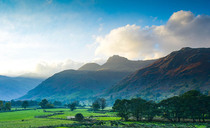
Dairy farms are abundant in the Dorset hills near Bridport, but the area does not lend itself to a single super-sized unit.

Denhay Farms has evolved since the 1950s to include five medium-sized farms, spread over a 15km (nine-mile) radius.

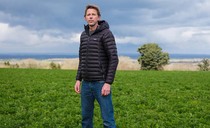
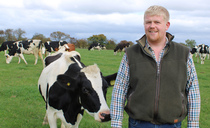
On top of the challenge of managing more than 1,000 cows and youngstock across those units, farms director Simon Hill has to guarantee top-class welfare, and milk to supply the company’s cheese business.

Producing Waitrose’s own-label West Country farmhouse cheddar, as well as its own award-winning farmhouse cheddar, Denhay Farm is RSPCA Freedom Food accredited and has to meet demanding quality and welfare requirements.

Selling milk from the farm to the processing side of the company at the Milk Link equivalent price, it has to be profitable.

“One of our biggest challenges over the past five years has been improving herd fertility,” says Mr Hill. “We wanted to rear all our own replacements as, despite buying in the best heifers we could afford, they never performed as well as our own.”

But with a calving index of 426 days and rising, producing enough replacements was proving a massive challenge.

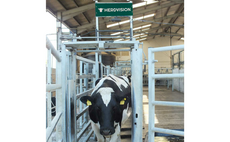
The units range in size from 140 to 350 cows and now a breeding company is used to observe cows daily, monitor bulling activity and inseminate the cows.

Although it costs £22 per cow each year, Mr Hill is convinced of the benefits. “We started on one dairy and have rolled it out to three others. The gain has been massive,” he says.

Not only have semen costs fallen, the farms’ calving index has dropped to 390 days, representing a saving of £149,000 - or 2ppl a year - putting the business at the top of Promar’s benchmarking results. With the use of more sexed semen, the farms produced 345 heifer calves over the past year, compared with 297 the year before, negating the need to buy in new replacements.

However, better observation was only one part of improving fertility - the other was changing the feeding regime. Previously, rations had become increasingly protein rich in a bid to boost milk yields.

Feed balance

To redress the fertility problems, Mr Hill and farm manager Brian Huxter altered the feed balance to promote better body condition. It had the desired effect and, although milk yields fell from 8,000 litres sold to about 7,700 litres (excluding calf rearing and wastage), milk quality improved to 4.4 per cent butterfat and 3.4 per cent protein.

“Milk quality is a driving issue for us - if we produce low quality milk we get less cheese,” says Mr Hill, explaining that as milk quality fluctuates during the year, the amount required for 1kg of cheese ranges from 8.8 litres to 10.44 litres.

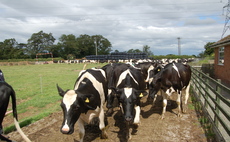
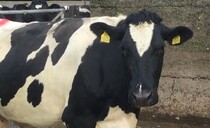
“We calve our Holstein Friesians all year round and work hard not to let milk quality drop during the summer.”

Making good quality silage is key to milk quality and yields, but five years ago Mr Huxter started using a mixer wagon across all the farms to complement silage with other ingredients.

“It allows us to feed straights, which are cheaper, and to present a better fibre to the cows,” he says. “They are all getting an even, balanced ration - we don’t get any displaced abomasums any more, which in itself helps fertility.”

With 747ha (1,845 acres) in total, the farm workers make about 280ha (700 acres) of grass silage, 182ha (450 acres) of maize silage and 60ha (150 acres) of crimped wheat.

The lighter land is double cropped with maize and Italian ryegrass. Clay soils are sown to a typical ryegrass and white clover mix. Taking three cuts on most leys, they cut and bale any fields which get away from the cows.

In a normal year, staff expect to gather 14.8 tonnes per hectare (6t per acre) of grass at each cut, with consistent results of 11.6 ME, 13.3 per cent protein, 28 per cent dry matter and a D value of 73. All clamps are sampled and analysed, with grass silage layered under maize and crimped wheat.

Maize energy

“We try to feed maize right through the year - it is our major energy source, but it’s difficult to eke out,” says Mr Huxter.

Chop length is critical and the farm’s contractor is happy to adjust cutting blades accordingly. Mr Huxter also uses a biological inoculant and double-sheets all 13 silage pits to improve fermentation and prevent wastage.

This year he is using a software programme linked to the mixer wagon to ensure cows are receiving the optimum ration, whether housed or at grass.

By feeding a balanced TMR all year round, he hopes to minimise disruption to the rumen, eliminating acidosis and optimising feed efficiencies. The computer stores all the different rations, making the herdsman’s job, covering 20 miles a day and feeding up to 20 different rations, easier.

Cows are fed indoors, either before or after milking, which presents its own challenges for grassland management.

“You can’t overemphasise the importance of forage quality, and we try very hard to keep our swards good,” says Mr Huxter. “But it’s very difficult when you are buffer feeding because the cows lose their appetite.”

Usually cows are turned out in March and housed in September, with the 630 youngstock grazed on hillier ground across three dairies. Turned out when swards are at about 12cm, cows are moved to new pasture when they have grazed it down to around 6cm. Slurry is injected to speed up the rotation and reduce air-borne nutrient loss.

“Injecting has definitely cut our fertiliser bill and we are keeping the farm’s fertility more even,” he says.

Welfare

Mr Hill says health and welfare is another pressing issue for the farms, as most of the facilities have not been upgraded since the 1970s.

“We would like to rip out a lot of cubicles and start again, which we have done on a couple of units, but we haven’t made enough money to do so over the past 15 years,” says Mr Hill, adding investments have been made in farm tracks, loose yards for newly-calved cows and new mattresses in every cubicle.

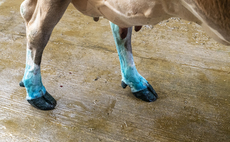
Every cow is foot-bathed at least four times a week to prevent digital dermatitis, and herd managers meet with Promar once a month to examine data on lameness, mastitis, gross margins and more.

“We have dedicated herdsmen for each of the dairies, and 18 staff overall, sharing a lot of the general jobs between us,” says Mr Hill. “We’re extremely vigilant about disease issues because our end products are sold directly to the public and we have very good traceability.”

With each unit responsible for its own budgeting, the past year has produced a 1.6ppl profit.

“That compares very favourably with the top 25 per cent of the benchmarked herds,” says Mr Hill. “I think the future is bright for dairying, given the diminishing amount of milk around.

“Food security is going to become a big issue, and it is nice for farmers to be more valued than we were five or 10 years ago.”

With so many uncertainties ahead, including the impact of climate change, he hopes the flexibility of the system will prove beneficial.

“We have just evolved slowly, and our goals are simply to keep becoming more efficient and maintain fertility,” he says. “It is challenging having such a complex business, but it is also a very rewarding job.”

Have your say

Mandatory
Mandatory
Mandatory
Mandatory

Farmers Guardian newsletters

Get the best of Farmers Guardian delivered straight to your inbox. Click here to sign-up today