A dual purpose breed that is very good for business
THE Fleckvieh is the world’s second largest dairy breed, but is virtually unknown in the UK. Jane Brown finds out what it has to offer.
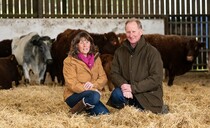
At first sight you could be forgiven for thinking Tom Voizey is a beef farmer, not a dairy producer.
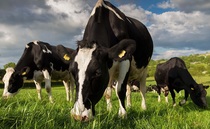
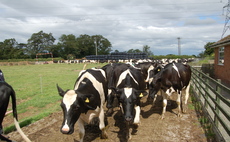
Sheds full of well-muscled cows with red spots and white heads stand, rather incongruously, next to a 14 by 14 herringbone parlour, although on closer inspection, you will see not Simmental beef cattle, but productive milking cows bedded in sand cubicles and capable of yielding almost 150,000 litres in a lifetime.
The Fleckvieh is a dual-purpose breed with superb fitness, top quality milk and the ability to produce an exceptional beef calf. First imported to the UK by Tom and his wife Emmeline four years ago, it is a sleeping giant, well known and trusted almost everywhere, it seems, except here.
Key traits
- Dual purpose breed with good milk and beef production
- Strong feet and legs, excellent longevity
- Metabolically stable, good forage converters
- High milk quality with low somatic cell counts
- Docile, fertile, and easy to keep
“I really believe the Fleckvieh has a lot to offer the UK dairy industry as a pedigree breed, and not just as part of a cross-breeding programme,” says Mr Voizey.
Genetics
“There are millions of cows in Europe and a huge choice of genetics within the breed to suit all systems, from grazing to intensive and everything in between.”
The Voizey family, who have farmed at Marsh Farm near Crewkerne, Somerset, since the turn of the last century, have always been interested in sustainable genetics. Mr Voizey’s father Richard started using Dutch MRI semen on his Holstein Friesians 20 years ago, in a bid to breed a hardier milking cow with better beef calves.
“We went to Holland four years ago to get more MRIs, and there weren’t many around, as so many farmers had moved to Fleckviehs,” says Mr Voizey. “Our agent took us to view a Fleckvieh herd and we fell in love with them at once.
“I was looking for a cow that could average 7,500-8,000 litres, with strong fitness characteristics like longevity, low cell counts, good fertility and great feet, which is able to produce a high value beef calf to sell or finish, and with a good temperament and cull value. These were perfect.”
Since then, he has imported 60 pedigree in-calf heifers at a cost of about £1,650 each, delivered. While this may sound risky, the cows’ inherently good cull value, combined with a minimum value of £250 per bull calf, went some way to mitigating the exposure.
“Of the 60 I’ve imported, we have culled only one, which is testament to their hardiness,” says Mr Voizey.
“The breed is performance recorded in Germany and Austria, with 46 per cent of their merit attributed to fitness, including longevity, cell counts, fertility, stillbirth rates, calving ease, milking speed, and persistence. Milk quality accounts for 38 per cent of the index, with 16 per cent down to beef attributes.”
On average, the cows yield about 7,000 litres a year, with top performing herds in Germany at 11,000 litres and a record of 17,500 litres has been achieved. “You should get at least five lactations and the record lifetime lactation so far is 148,779 litres,” says Mr Voizey.
Ideal
At Marsh Farm, the heifers yield about 6,000 litres, second calvers 7,500 litres and third calvers 8,000 litres, with 3.6 per cent protein and 4.1 per cent butterfat making the milk ideal for its Wyke Farm cheese contract.
Cell counts are also exceptional, averaging just 55, dropping to 35 at the last count. “They just seem to get better the older they get. We never call the vet out for them and usually have just one or two cases of mastitis a year out of 60 cows,” says Mr Voizey.
“I milk twice a day and I’m usually in a rush to be somewhere, so don’t have the most thorough of milking routines. The cows are working for me, which is just as well.”
I really believe the Fleckvieh has a lot to offer the UK dairy industry as a pedigree breed
Tom Voizey
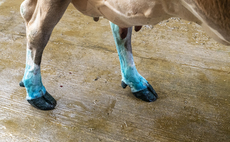
With strong, compact, feet, they rarely suffer from foot problems, and metabolic disorders are virtually unheard of. “The Germans and Dutch are very keen on metabolic stability, so we don’t get any problems like that.”
In addition, the cows’ hip bones are well above their pin bones, so calving is easy and post-calving infections minimal. “We calve the heifers at 26 months and the calves are full of vitality - they are performance recorded for their growth rates.”
The comprehensive recording programme, which in Germany alone tests 500 young sires and selects 5,000 bull dams for breeding each year, ensures buyers have access to cutting edge genetics.
Selection
“I usually select for milk, solids, udders, feet, legs and, on the heifers, calving ease,” says Mr Voizey. “The Germans and Austrians have put a lot of work into their breeding, and the breed has never fallen out of favour, unlike some of our traditional dual-purpose breeds.”
The Voizeys have now joined forces with Spermex to form Elite Fleckvieh Genetics in the UK, providing a direct line to some of the best bloodlines in Europe for both their own herd and other British farmers.
With the help of Mr Voizey’s father Richard and brother Ben, they now milk 160 cows, 60 of which are pedigree Fleckvieh, with 30 pedigree heifers coming up to join the herd.
Calving is all-year-round, artificially inseminating all the females to Fleckvieh genetics. “I want to move to an all Fleckvieh herd – our first home-bred heifer calved early in November and we’ve got some young bulls coming through as well. It would be nice to get to 200 cows or more.”
The first served conception rate is an impressive 71 per cent, with a calving index of 385 days. Any bull calves are either sold or kept to finish on grass at an R grade or better at 23 months.
Mr Voizey says he is ‘very excited’ about the breed and thinks they ‘are the future’.
With a growing family – starting with nine-month-old daughter Olivia – the couple are keen to invest and improve profitability.
The 176 hectares (440-acre) farm is predominantly grass, with 20ha (50-acres) down to maize for silage. “This year we grazed from mid-March to mid-November – it’s heavy land so all the cattle are housed over the winter.”
They receive 5kg of cake in the parlour all-year-round, with a 50:50 grass and maize silage mix plus 3kg of soya in the winter. “They are very strong grazers and forage converters.”
Paperwork
Even Mrs Voizey, a self-confessed ‘townie’ before marrying Tom, is sold on the breed and has taken on all the paperwork for the farm and the genetics business. “They are so placid and friendly,” she says.
“We get a lot of farmers coming to look round who are interested in them for cross-breeding, and I absolutely love them. We built a new shed when we expanded the herd, which we call the Fleckvieh Hotel.
“In the future, we plan to sell pedigree heifers and stock bulls and to build up Elite Fleckvieh Genetics for our family.”
The breed offers great benefits to UK farmers in terms of milk production and quality, fitness and beef characteristics, says Mr Voizey.
“The Fleckvieh are very strong, healthy animals, a trait consistently enhanced by the Germans and Austrian AI companies, who have put decades of work into the genetics of the animal. I am very excited about the future.”
History of the Fleckvieh
FLECKVIEH cattle originated as a mountain breed in the Swiss Alps, possibly in the 13th Century.
Breeding work began in the 15th Century, and the breed was successful at the Paris Exposition in the 19th Century, sparking large-scale exports to Germany and Austria.
Although early breeders selected for draft and work performance, later breeding focussed on milk, beef and functional traits.
The beef side has enjoyed worldwide importance under the Simmental name, while the dual purpose and dairy Fleckvieh has grown in popularity across central and Eastern Europe throughout the 20th Century.
There are now 9 million cows in Europe, 1.3 million of which are listed in the European Fleckvieh Association herd book, making it the second largest dairy breed in the world.
Farmers Guardian newsletters
Get the best of Farmers Guardian delivered straight to your inbox. Click here to sign-up today
-
General news and breaking news alerts
Minimum weekly delivery -
Livestock, arable, dairy and young farmers
news and features
Monthly delivery


By unlocking the export potential China offers the pig industry, not to mention the red meat sector as a whole, we could gain entry into a marketplace which comprises a fifth of the world’s population.