Bovine TB is a constant in NFU Cymru deputy president's life

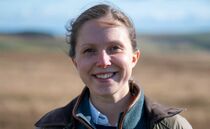
AT home and away from his Pembrokeshire dairy farm, bovine TB has been an on-going dilemma for Stephen James for the best part of 17 years.

Having now taken on the mantle of NFU Cymru vice-president the coming years are going to be even more challenging.

The all-grass 121 ha (300-acre) Gelly Olau holding he farms in partnership with his wife Joyce, and son, Daniel, near Clynderwen, has suffered from the consequences of TB on and off since 1993.

“Recent years really have been testing times with either one or two animals showing up positive or as inconclusive. That means being shut down time after time and all the problems that brings of not being able to sell surplus stock,” says Mr James.

“Our longest continuous stop period has been three years.”

Though the farm will not be within this spring’s planned Welsh Assembly badger cull area, naturally he welcomes the fact that at long last an holistic approach is being taken.

“I have every sympathy with wildlife supporters opposed to culling - but with 12,000 cattle slaughtered in Wales alone last year as a result of the disease you can no longer go on tackling the problem in one species alone,” he says.

“No-one wants to see healthy badgers culled - but there comes a time when unpalatable decisions have to be taken.

“Hopefully by adhering to strict cattle movement controls and better on-farm bio-security measures we can at last get to grips with such an insidious situation.”

He points to the fact that Gelly Olau is virtually surrounded by natural barriers, with council roads, a river and a railway line, as well as double fencing, preventing contact with neighbouring cattle and was one of the farms involved in trialling increased on-farm bio-security measures.

A 150-acres holding several miles away is also being rented to rear home produced dairy replacements in complete isolation to the main milking herd.

Maize has not been grown on the farm, either, for several years - and still TB has been an on-going problem. The only avenue not tackled has been the local wildlife.

Endemic

“Maybe one day vaccination could be the all round solution - but that is a long way off, perhaps even 20 years or so, and even that will not get rid of the disease in areas where it is endemic,” he says.

His role as NFU Cymru’s TB spokesman is one he will be retaining as he takes on his broader involvement in agri politics.

One of the key areas he is also keen to pursue is the introduction of measures that make it easier for the younger generation to get a foothold within the industry, even to the extent of encouragement for older farmers to step aside and maybe forge business relationships with follow-on generations.

That is something that has already happened at Gelly Olau where for the past five years Daniel has been taking on more of the lead role.

Knowing that there was a secure family follow-on has, in fact, led to an expansion in cow numbers from 200 to what soon will be 300 milkers.

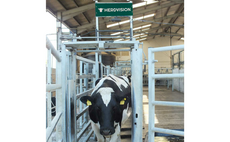
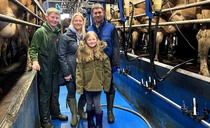
Currently under construction is a new extension which will house dry cows and still working well is the farm’s unique 30-30 rapid exit parlour first featured in Farmers Guardian when it was installed five years ago.

It replaced what had started out as an 8-8 herringbone back in the 1960s and extended to a 14-14 in 1981.

By no means off-the-peg, the new unit was put together using equipment from a range of manufacturers and countries.

The stallwork came from Australia, the milk line was also from Australia, the milk meters and pulsators from Israel and the feeders from the UK.

Throughput

Summer milking times are put at 150 to 165 cows per hour with just one person milking while winter throughput, because of wiping and teat dipping, is around 120 an hour.

“At the time we thought the parlour was rather too big for what we needed, but now that we have more cows it really has come into its own,” says Mr James.

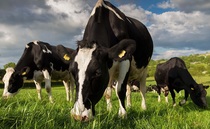
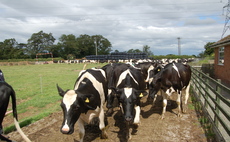
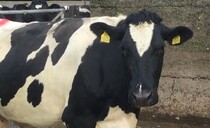
Cows are cubicle housed from early November to mid-March or early April, with the all-year-round calving commercial Holstein-Friesians showing a 7,500-litre per cow average yield.

Some of that is down to a breeding programme geared towards longer lasting cows with sound legs, feet and udders.

But feeding stale bread shipped in from bakeries and layered with brewers’ grains underneath grass silage is playing its part, too.

“We started with the bakery waste after a disastrous experience with growing maize on our heavy ground and 60 inch annual rainfall,” adds Mr James.

“The first year’s crop was no problem but the following year because it was so wet we only had half a crop from the same acreage.

“It was decided there and then never to have maize again. The hassle was just not worth it.”

Like it or not, however, the cost of the bread has risen from £50 per tonne delivered five years ago to £90 today.

“In all we buy in around 90 tonnes of bread and 150 tonnes of brewers’ grains for each of our three silage cuts.

“It all goes into the mixer wagon, together with a bought-in blend, and we feed concentrates in the parlour according to yield.”

Slurry is scraped into a concrete walled storage lagoon, minus roof water which is all collected, stored and used for parlour washing.

A recently installed heat exchange unit linked to the bulk tank has also cut the electricity bill for milk cooling and water heating.

Mr James is a former regional director of First Milk and all of the farm’s output goes to its Pembrokeshire Cheese operation.

His enthusiasm for co-operation also extends to being a director and former chairman of the highly successful farmer-owned Clynderwen and Cardiganshire Farmers co-operative.

He feels passionately that to some extent farmers can be their own worse enemy in failing to take advantage of the benefits collective buying and selling can bring.

That is another avenue he hopes to pursue during his union leadership stint.

Have your say

Mandatory
Mandatory
Mandatory

Farmers Guardian newsletters

Get the best of Farmers Guardian delivered straight to your inbox. Click here to sign-up today